


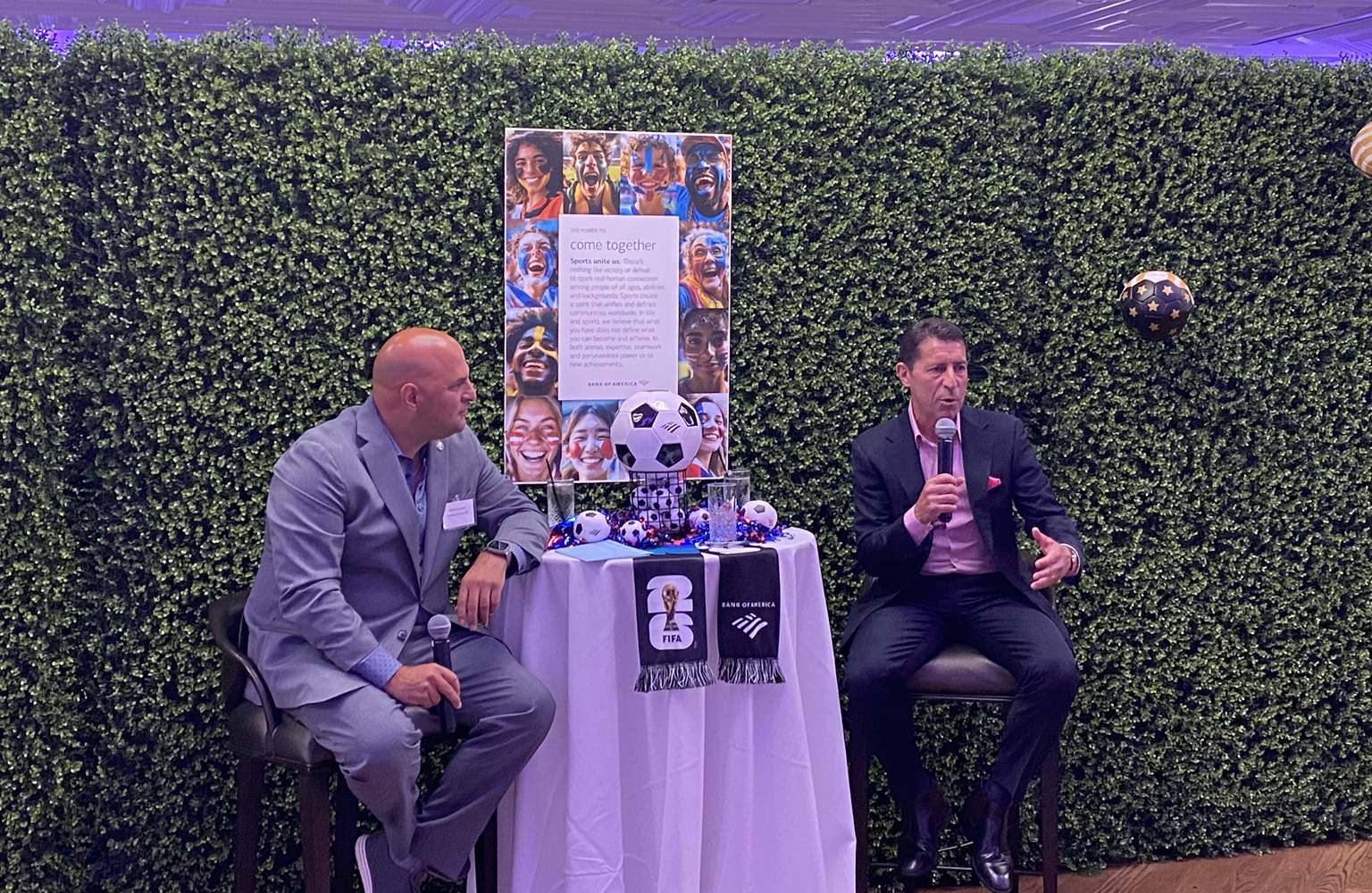
Tab Ramos is one of the stars who helped revive soccer in the U.S. in the 80s and 90s, played on three World Cups and overcame a life-threating injury to earn a spot in the U.S. Soccer Hall of Fame.
Along the journey, he never picked up an ego.
Humble, gracious and soft spoken, Ramos was a class act when he offered sound advice on life, business and sports to a crowd at Suneagles Golf Club in Eatontown Thursday night at an event sponsored by Bank of America.
In a fireside chat format with Alberto Garofalo, Bank of America’s New Jersey market president, Ramos detailed what is was like to move to Harrison from Uruguay when he was 11 (he was immediately forced out of the local rec league when they saw his talents), to be on the first U.S. team to qualify for the World Cup in 40 years, going to Italy in 1990 (‘We were tourists,’ he said) to suffering a cracked skull in a horrific incident in a 1994 World Cup game against Brazil (doctors said returning to the game could lead to a catastrophic result) to his life as a youth coach (good advice for parents coming).
In nearly 90 minutes of conversation — and a dozen questions — Ramos touched on all of this and more.
How do you wrap all that up in one story? We’ll try by simply letting his words speak for themselves.
Here’s a look at some of conversation, slightly edited for space and pace.
On moving to the U.S. in 1978 — a country with little passion for soccer
Uruguay is the complete opposite of the U.S. in terms of soccer. If you were to combine the interest in the NFL, MLB and the NBA together, that’s what soccer is in Uruguay to every child that grows up. Coming to a country where soccer barely existed at the time was tough. But I was very lucky. I could have landed anywhere in the U.S., and I ended up landing in the place that had a soccer history (Hudson County).
Soccer helped me find my way here. I went to Holy Cross School in Harrison. I had no friends. One day, I was in the playground kicking the ball on my own, and this kid came up to me and said, ‘You kick the ball pretty good. You should sign up for rec soccer.’ I had no idea what rec soccer was, but I wanted to play.
When I showed up, I saw kids in knee pads and goggles. It didn’t reflect the soccer that I had seen. Also, rec soccer in Harrison was on the outfield of a baseball field. It was small. I could score every time from a goal kick. So, after five minutes, they didn’t allow me to play anymore. No exaggeration, maybe five minutes. They said, ‘We have to take you to Kearny to play travel soccer.’
The club in Kearny was mostly Scottish and Irish, but it was my type of atmosphere. Even though they came from a completely different part of the world, we had something in common — how we felt about soccer. So, soccer became a way for me to make friends and to meet people, because I was really alone.
On helping the U.S. qualify for the 1990 World Cup
Our last game of qualifying was in Trinidad and Tobago. They just needed a tie to qualify for the World Cup for the first time ever. We needed to win the game. Their president was so confident that he had already declared a national holiday for the next two days after our game.
It was tough. As soon as our plane landed, there were people everywhere. At our hotel, there were bands and fireworks. They wanted to be sure that we couldn’t sleep. The stadium barely held 25,000 people, but there must have been 45,000 on that day. Tickets didn’t matter. People climbed over fences. When you looked up in the stands, you couldn’t even see the stairs. It was just a sea of red.
(But)
The tunnel before you walk out for the game is a very important moment. That’s the place used for intimidation; teams yell and scream at each other. Those moments are really important. On this day, the Trinidad and Tobago team had so much pressure on them. I remember seeing it on their faces. I knew we were going to win the game before it even started. We won, 1-0.
On that 1990 World Cup team — essentially a group of college all-stars — building the foundation for soccer in this country today
Now that I’m old, it means a lot when I look back at those moments. At the time, we didn’t know all the things we didn’t know. We just played. We knew the U.S. had not qualified for the World Cup in 40 years. And I would love to tell you that we believed from the beginning that we were going to be the first ones to do it, but it was really just playing one game at a time.
I was lucky to be from a generation of players who were all leaders. They would never take ‘No’ for an answer. They would never think a game was too important or too big. They never refused a challenge. And it was a group of players who would learn from losses.
(Most of all it was teamwork, he said)
No one was responsible for my development or what I did on the field, but yet I depended on everybody else. At the end of the day, as much as you have to look out for yourself and do as well as you can, it’s always about the team.
We knew we needed each other. If we had a weak link, none of this would have happened. Maybe we’re not sitting here today.
On the horrific episode during the 1994 World Cup, when he suffered a fractured skull that sidelined him for six months and nearly ended his career.
I got hit with an elbow that broke my skull. I had internal bleeding and I went to the hospital at halftime. I remember speaking to a doctor, who was the doctor for the U.S. Olympic boxing team. He said to me, ‘If you were a boxer, I would not let you compete again.’ He said, ‘I wouldn’t let you take the chance.’
(The doctor said a blow to the head with a ball could cause him to lose his ability to speak – or worse).
At that moment, I realized that soccer is not the most important thing in the world, because it was me — but I also realized that I couldn’t live without it. So, I had mixed feelings about that moment, because I probably should have quit playing. But I didn’t, because I felt like it would have killed me inside to quit the game.
On the current state of MLS, which was an outgrowth of the 1994 World Cup
Off the field, in terms of facility growth of the league, growth of the Federation, I think we’re way beyond where I could have ever imagined we would have been 30 years ago.
You have a league that’s built stadiums for each team. Everyone has incredible facilities that are so far beyond what we could have ever imagined, yet their fans are limited to a very small base within their community. We have yet to penetrate the mainstream market.
I always like to say, ‘If I walk into a bar, what are people talking about, what are they watching?’ In the early 90s, you would rarely find a soccer game anywhere. Now, on a Saturday, if you go to a bar, you’ll see an English Premier League game. So, people know soccer, but it’s still not within the mainstream of the U.S. We haven’t closed that gap as much as is possible.
(Should it be viewed like hockey, a sport with a limited passionate audience, as some suggest?)
No, I don’t think soccer is like hockey. And I’m not sure if hockey is bigger than soccer, although if you do walk into a bar, you’re likely to find more hockey people than soccer people. But soccer is such a global sport. I think soccer can get much bigger than hockey. Could it be the NFL one day?
I’m not sure about that. I don’t think it can be basketball or baseball. But can it be the biggest of the next tier — tennis, golf, NASCAR, hockey — that’s the question.
On the state of the U.S. National team in the world. And how it gets over the hurdle of not just making the knockout stage of the World Cup but actually competing to win it.
Some of our players have tremendous skills, starting with Christian Pulisic. Many of our players are playing overseas. But we’re still not there yet. Our players have to be players carrying their teams in Europe. They have to be the best player on their team in Europe, as is the case with players from other countries. When you have four or five players who are the best players on different teams, then you’re looking at a team that has the potential to really compete.
But we have to appreciate the little steps that we have taken. We didn’t even have a league in 1994, now we have a league of 30 teams that is doing well. They have their stadiums, and more importantly, they have their training facilities. They are now developing more players, and I think better players. So, we’ve come a long way. But we still have a way to go.
On the state of the current men’s national team
I was pleased with the results of the team in the Gold Cup because they made it all the way to the final. Even though they lost, I felt that the roster was not really good enough to win, so maybe they overachieved a little bit.
But I have to say I’m a little disappointed with the growth of the team. (Head coach Mauricio) Pochettino has now been there for 10 months, and the growth has been very little. I think the coach is starting to understand the mentality of our players and the culture of soccer in this country. I think maybe he assumed, because he’s Argentinian, and he coached in England, and he lives in Spain, that the kids who are coming up now were a lot further ahead off the field than they are. Maybe he thought that the value that our players give the national team is the same value that other kids give to their national team in other countries. Our culture just isn’t there yet. And I think it’s taken him 10 months to understand that. In a way, I feel like we’ve wasted 10 months to get to today.
On his hero, the iconic figure he worshiped
I have about 150 jerseys in my basement that I’ve collected over the years, many are from great players, including Maradona. But I only have one picture in my office, and that’s me and Pele. What Pele did for soccer worldwide, no one will ever match. He brought the sport into everyone’s home. He was an idol no matter where we went. And most of all, he was a class act.
On coaching — and the lessons learned
When I retired from playing, I started coaching my kids like everybody else, and I fell in love with the game from a different place. As a player, I didn’t really understand it. I played it, and I kind of listened to my coaches, but this was different.
I wanted to be a professional coach. I went to a seminar on coaching and next to me was a famous coach in Spain who had coached in the World Cup. He asked me, ‘When did you retire?’ I said, ‘A year ago.’ He said, ‘Then you don’t know anything about soccer. You can’t be a pro coach yet. Go coach 9-year-olds, spend some time with them, and slowly move up.’
That’s what I did. It didn’t make sense at the time, but it helped me go on to coach the youth national teams for eight years and then in the pros, with the Houston Dynamo.
In my time in the youth game, I really learned the game, but I also learned about the lessons that the kids get. I think parents get so ahead of themselves about their kids trying to win things. I think every child, whenever they get on a field, should play to win. But I think winning is not the most important thing. It’s not about getting a child on a winning team so that they can win games. Sometimes, it’s about your child being the best player on a bad team and trying to carry that team. There’s not a lot of learning when you’re winning. All the learning comes when you’re losing.
It’s OK if they lose. It’s OK if they cry when they lose. I think we’re in a world now where we feel like, if our kids are disappointed, we let them down. That’s not how the world works.
On the biggest lesson he learned from kids (his own)
My youngest daughter is now 17. Her two older siblings played soccer. So, we put her in soccer. She didn’t want to play. She had only one year of rec soccer. One game, from the middle of the field, she said to us, ‘Why are you making me do this?’
She wanted to be a dancer, and she has been dancing for the last 10 years — and we’ve supported her. It’s important that you’re supportive of whatever your kids want to do. Remember, it’s about them, it’s not about you.


