


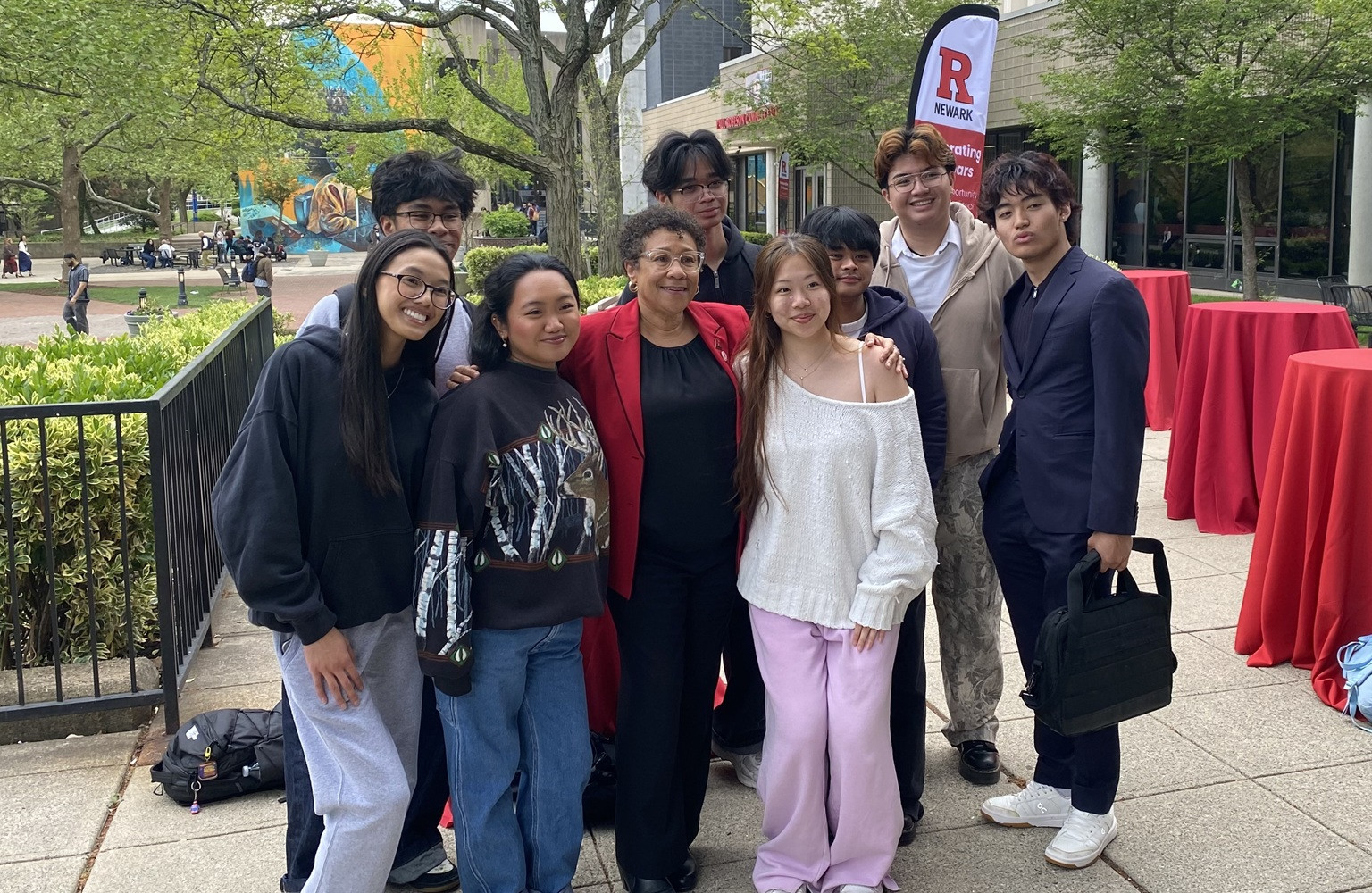
Tonya Smith-Jackson didn’t fully understand all she was stepping into when she assumed the role of Chancellor of Rutgers–Newark last summer.
Its role as a rising center of academic excellence? Sure.
Its position as a leading urban institution in the state, the region and the country? Of course.
But its unique connection to a city — and a growth that parallels the rise of Newark over the past decade, if not the past two generations — is something that requires lived experience.
Smith-Jackson, speaking at an event Thursday afternoon celebrating the 80th birthday of Rutgers–Newark, said she has gotten that lesson on a daily basis. And she’s loved every minute of it.
 “Rutgers–Newark is an incredibly unique place,” she told BINJE. “Newark often is overlooked and underestimated. But it’s inspirational.
“What people don’t know is that when you set your foot in Brick City, it’s an absolutely transformative experience. There’s so much to do, there’s so much intellect, there’s so much innovation and creativity — and it’s all right here in this dense space that we call Newark.”
Smith-Jackson said she has been overwhelmed by the support of Mayor Ras Baraka, a former educator in Newark.
“He has been a great partner,” she said. “He has a strong sense of who we are and what we need.”
The same goes for the city’s business community.
Smith-Jackson rattles off the support she has received from Audible, Panasonic and, of course, Prudential Financial. She talks about the deep collaboration the school has with NJIT, literally a block away.
“It’s incredible,” she said. “It’s a community.”
It wasn’t always that way.
***
Richard Roper came to Newark in the mid-1960s looking for work. He found a place where he could continue a college experience that began in what would now be called an HBCU in West Virginia.
As much as he liked the school, he could see it was not reflective of his new home — or the changes taking place in Newark and across the country.
Simply put, there were not enough opportunities — hardly any, in fact — for Black students, Black faculty or the greater Black community.
Roper was named president of the campus chapter of the NAACP. And when he felt that group was not doing enough, he gathered a group to create the Black Organization of Students, or BOS, to push policies that would do more to help the Black community in the city.
The impact was great. Roper graduated in 1968, but BOS carried on and led the famous takeover of Conklin Hall in 1969 — an event connected to the greater racial reckoning that was going on in the city at the time.
Today, attending an event as an esteemed alum, Roper is overwhelmed to see a beautiful campus — far bigger than it was when he attended, he said — and far more accepting of first-generation Newarkers.
“This is beyond my wildest dreams,” he said. “This is far more than I could have ever imagined or hoped for.”
***
Rutgers–Newark is now a Top 100 university in the country, according to the prestigious U.S. News & World Report rankings.
Smith-Jackson said the school’s true value is not how it is seen from afar, but what it can teach those outside the area who do not truly understand Newark.
“We have to take the talent we already have and focus it on areas unique to us,” she said. “One of those areas is research.
“Not everybody can bring a lens that we can bring to societal challenges and community engagement. We bring a lens of diversity and a lens of lived experience that others who study this may not always be able to bring to the table.
“We can do very inclusive research that in so many ways is much better than any other institution because we’re attached to our history — and the city’s history of struggle and fighting for civil rights.”
That attachment to the city is the key, Roper said.
He credits former Chancellor Nancy Cantor for connecting the school to the city in a way he and others never thought possible back in the 1960s.
“She made sure we were of the city, not just in the city,” he said.
***
The ultimate mission of any higher-education institution is education.
Smith-Jackson said that’s a part of the role she did understand on Day One.
“One of the things I’m focused on is continuing to make sure we’re building a stronger set of resources for our institution — not just from the state, but also from other portfolios,” she said.
“We need people who are willing to invest in the dream — the dream that students will be able to come here and get that golden ticket we call a college degree.
“Everybody has a right to it. And we want to expand that space where everybody can come in, no matter what your background is, and get that golden ticket.”


