


Here are the first two simple facts about hiring neurodiverse individuals:
- All studies show neurodiverse individuals are incredibly dedicated and loyal employees who can help increase productivity (i.e. the bottom line) while serving as a catalyst for improving corporate culture (who among us does not have a relative or friend on the spectrum that you would love to see employed).
- Not enough companies are hiring neurodiverse individuals. All studies indicate approximately 1 in 6 neurodiverse individuals are employed — and those who have been hired are most often underemployed (i.e. not serving in roles that are equal to their abilities).
That’s why State Sen. Andrew Zwicker (D-Hillsborough) has introduced a series of bills that would incentivize companies to increase neurodiverse hiring.
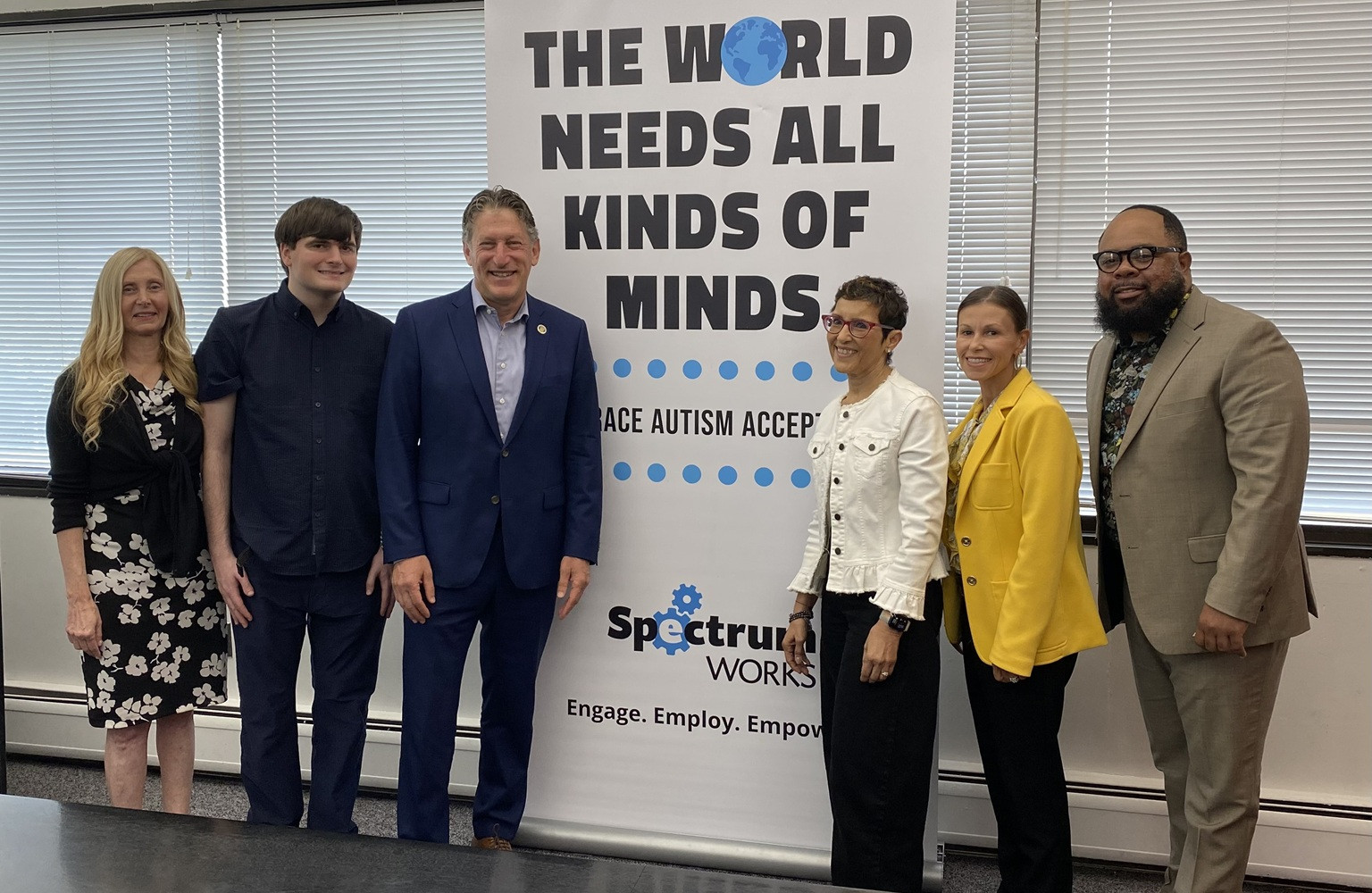
It’s why Zwicker was in North Bergen Thursday – many miles away from his home district – to salute Bergen Logistics for its internship/hiring program and discuss the challenges and opportunities that come with such initiatives with representatives from Spectrum Works (a leader in helping the neurodiverse gain employment) and two higher ed institutions doing their part: Middlesex College and Stevens Institute of Technology.
Zwicker first detailed his plan last fall as the keynote speaker at the groundbreaking NeuroX conference in New Brunswick.
“Let’s make New Jersey a career destination for neurodiverse talent,” he said then.
In January, he introduced a set of three bills that will do just that:
The Tech Talent Pipeline (S-4119): It addresses barriers faced by neurodiverse students in higher education and workforce development with a focus on county colleges while encouraging collaboration with four-year institutions. A major component is the Accessibility Coordinator Pilot Program, which will establish dedicated staff positions at three county college campuses — one in North, Central and South Jersey. These coordinators will provide tailored academic advising, resource navigation, and employer connections for neurodiverse students, ensuring they have the support necessary to succeed. Operating with a two-year pilot, this program is designed to create a replicable model for inclusivity in higher education.
The Neurodiverse Employment Tax Incentive (S-4120): It offers tax credits to employers hiring neurodiverse individuals in STEM and AI roles. To encourage retention, the tax credit increases over time: employers can receive $7,000 for each full-time employee in the first year, $8,000 in the second year if the employee remains with the company, and $9,000 in the third year, where the credit caps. Part-time employees also qualify, with employers eligible for a $4,500 credit. These incentives not only provide meaningful opportunities for neurodiverse individuals but also address underrepresentation in high-demand fields while fostering long-term employment relationships.
The Inclusive Workspaces Initiative (S-4118): It focuses on fostering neurodiverse-friendly workplaces through financial incentives for employers. Small Business Workplace Inclusion Grants and Employer Tax Credits, administered by the N.J. Economic Development Authority, will provide funding for workplace modifications, including sensory-friendly layouts and adaptive equipment. This initiative ensures that businesses of all sizes have the resources to embrace neurodiversity, enhancing workplace inclusivity.
Together, these legislative efforts reflect a comprehensive strategy to educate, employ, and empower neurodiverse New Jerseyans and make the state a leader in inclusive education and workforce development, Zwicker said.
Which leads to two more simple facts around neurodiversity hiring:
3. Zwicker was not expecting these bills to move earlier this year – when the emphasis was on creating a budget impacted by uncertainties in Washington;
4. No one is against these measures – so there is hope that they will move during the lame-duck session later this year.
Zwicker is confident.
“This has bipartisan support,” he told BINJE at the event. “Nobody is against it. And it is a small amount of money relative to the space the state budget, with an enormous return on investment.
“So, the goal is to push hard to get it done and on the governor’s desk before the end of the term.”
Zwicker stressed at the event that hiring neurodiverse individuals is not charity. It’s good for business. He has seen this personally.
Zwicker, who has Ph.D. in physics from Johns Hopkins University and has been a longtime employee at the Princeton Plasma Physics Laboratory, knows how much neurodiverse individuals are leaders in STEM fields.
Then there’s this.
“Quite frankly, it’s just good common sense, because the return on investment is significant,” he said. “It’s success for the company; it’s success for the individuals, and it’s success for New Jersey’s economy.
“It’s a win-win all around.”
Which leads to the final simple fact around neurodiversity hiring:
5. It’s not going to change until readers like you – in positions of influence that you have – make the decision to step up.
Looking for a place to start: Check out the Spectrum Works web site here and reach out to Ann Marie Sullivan, founder and CEO, at [email protected].


