


Advancements in decarbonization and energy efficiency which help increase grid capacity don’t always have to come with years-to-implement energy-master plans, controversial billion-dollar projects and enough political posturing that you have to wonder what the end goal really is.
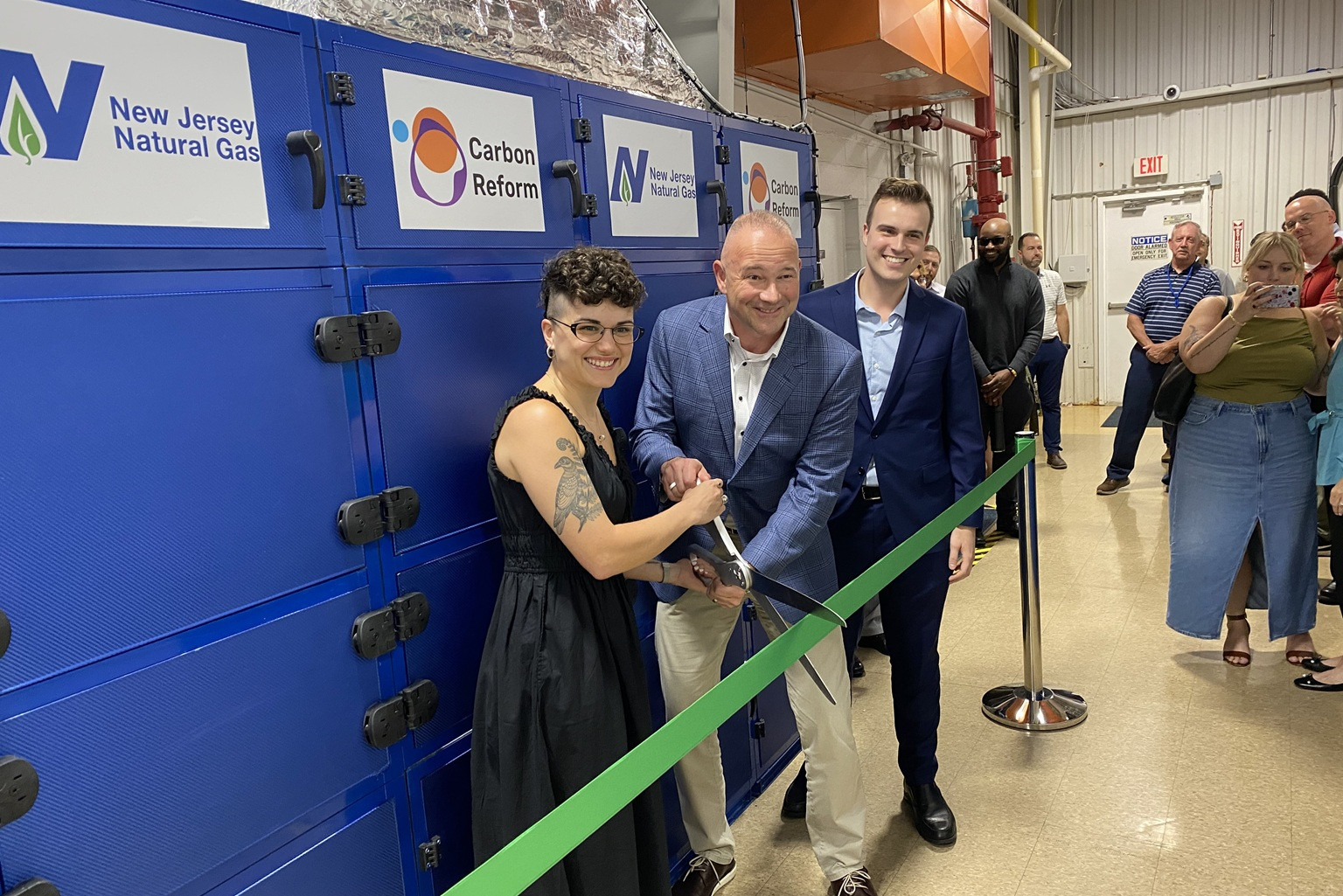
Sometimes, it is just simple but effective cost-effective solutions — such as the carbon reduction system by Philadelphia-based Carbon Reform that New Jersey Natural Gas has had up and running in its Lakewood facility in a pilot project since May.
The modular units, which can be arranged in the same fashion as a set of lockers (and take up a similar amount of space), not only remove carbon dioxide but also VOCs (volatile organic compounds) by disinfecting for pathogens (think viruses and bacteria) — all while lowering energy use.
Jo Norris, the CEO and co-founder, explains it this way.
“It cleans the indoor air so that we can recirculate it back into the building — so it reduces the amount of outside air that’s required, which then reduces the energy usage of the building,” she told BINJE.
The unit at NJNG’s facility in Lakewood is just the third for the company, which was founded just before the pandemic, but the first in New Jersey.
NJNG Chief Operating Officer Patrick Migliaccio said the utility was thrilled to have the opportunity, saying it highlights the company’s commitment to advancing innovation and practical, cost-effective solutions to reduce emissions.
“This is just yet another example of the role that gas utilities and emerging technologies can play in the energy transition and, more specifically, decarbonization,” he said.
“When I think about the best-case opportunity, it’s projects like this. We’re able to reduce the amount of emissions into the atmosphere but also create an amazing energy-efficiency benefit.”
The unit already is showing a reduction of energy use in the building, Migliaccio said — who estimates that it could eventually lower costs by as much as 50%.
New Jersey Natural Gas and Carbon Reform intend to monitor the data through the end of the year — a timeline which matches perfectly with Carbon Reform’s plan to manufacture more units.
The two may then work together to bring this technology to commercial customers of New Jersey Natural Gas.
What the groups call the MUSH market — municipal buildings, universities, schools and hospitals — are all obvious candidates for this technology. Other commercial buildings (think New Jersey’s incredible warehousing sector) also are potential fits, Carbon Reform Chief Operating Officer Nick Martin said.
“The commercial building sector represents a significant opportunity for practical decarbonization solutions,” he said. “Our work with utilities like New Jersey Natural Gas demonstrates how building operators can achieve meaningful emissions reductions while maintaining focus on their bottom line.
“This deployment will showcase how the broad capabilities of our technology, pairing carbon capture with air purification functionality, integrate seamlessly with existing building systems to improve efficiency and reduce energy costs with measurable results.”
The cost of the units will be far lower than other proposed building electrification plans for many reasons — starting with installation.
Norris points out the beauty of the modular units — each one can service approximately 5,000 square feet — means they not only can scale to needs, but they can also fit into tight spaces, a huge concern in buildings that often were built years ago and have little room to place even the smallest of units.
Of course, the technology should not be viewed just as something to help upgrade or retrofit buildings of the past, this technology can help create more energy capacity moving forward — and obviously come at a time when that clearly is desperately needed, through the constant creation of AI data centers.
Norris said partnering with utility companies and other energy-based groups to implement the technology is part of the business plan.
In addition to having a unit operating in its own facility in Philadelphia, Carbon Reform has a system running in Maryland, in a facility used by Baltimore Gas & Electric. Norris said the company intends to scale the company quickly in the Northeast — but also has had talks with groups in Texas and Colorado.
When it comes to partnering with utilities, there is seemingly a bit of irony: Increasing energy efficiency means lowering bills. In theory, that would hurt a company that supplies energy.
Migliaccio chuckles at the thought.
“We’re OK with that,” he said. “And we’re happy to be the first user in New Jersey to see how this will work.”
Migliaccio said the units perfectly fit the mission and the vision of New Jersey Natural Gas.
“That is the perfect example the type of technology that we want to bring to bear, particularly in the commercial and industrial sectors, which candidly, are some of the hardest to decarbonize when we think about the massive amount of retrofits that might be needed for an alternative electrification,” he said.
“When I think about 10, 15, 20 years from now, I think carbon capture technologies will play an incredibly meaningful role. This is just the start.”


