


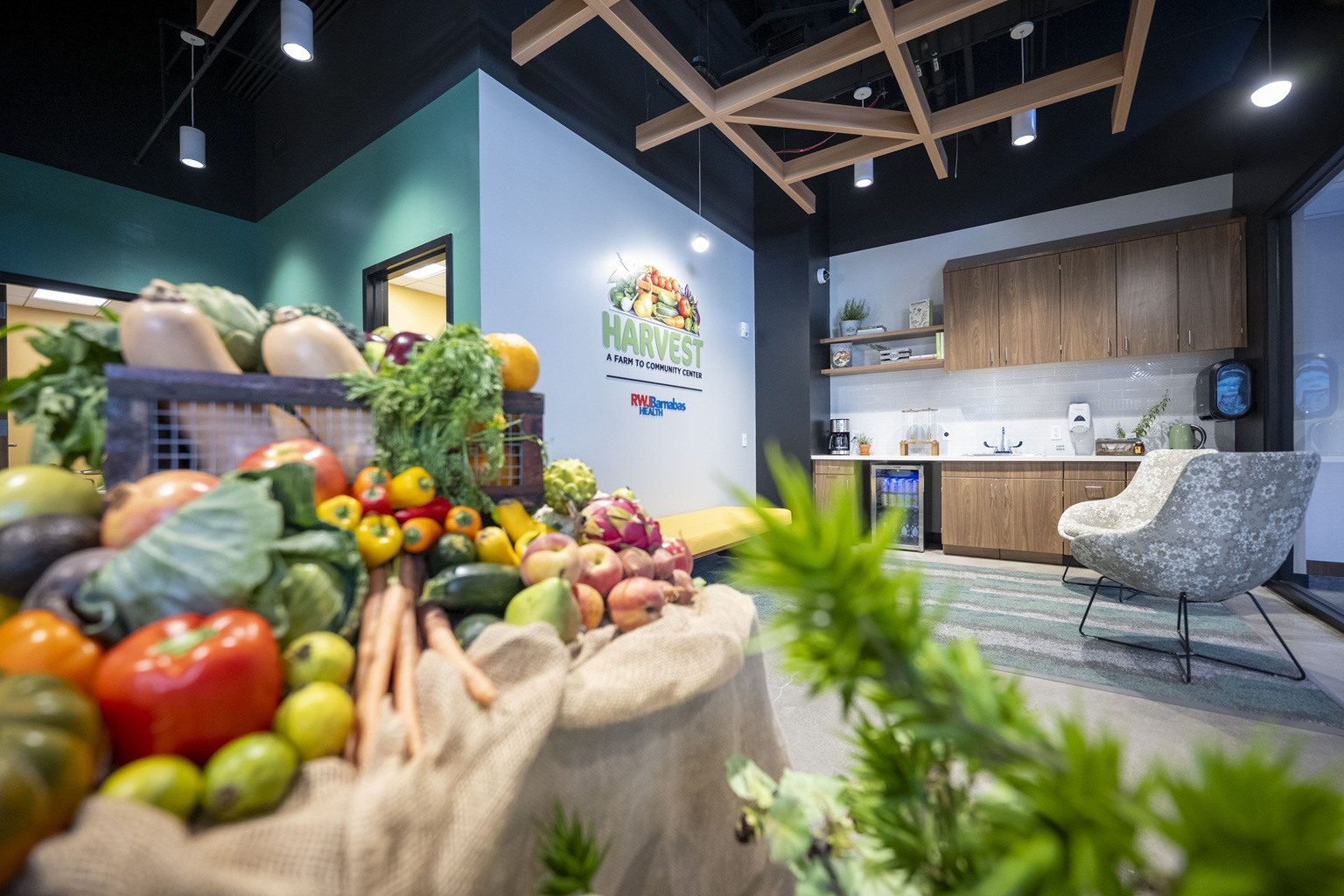
Harvest: A Farm to Community Center doesn’t look like a typical health facility. Because it’s not.
When you enter the facility, located in the Hahne & Co. building on Halsey Street in Newark, you don’t see a waiting room but a teaching kitchen and a commercial kitchen, rooms for consultation and wellness services — and a distribution center that brings in loads of food from New Jersey farms on a daily basis.
Harvest, a perfect example of RWJBarnabas Health’s “food as medicine” concept, opened Monday. It is part of the system’s Our Healthy Communities initiative, in which RWJBarnabas Health partners with local leaders, health care providers, clergy, civic groups and community-based organizations to strengthen critical social and health care infrastructure and expand access to care, healthy foods, nutrition education, transportation, economic mobility and stable housing.
Here are 10 things BINJE learned after taking a tour:
10. It’s open to everyone, not just patients
Although Harvest is rooted in Newark and aimed squarely at its highest-need neighborhoods, there’s no residency requirement at the door. The space is open to anyone who wants to learn, cook or connect with resources. That “community hub first, hospital program second” feel is intentional, RWJBH officials said.
9. The goal is to keep people out of the hospital
Harvest is built around prevention, not procedures. RWJBarnabas Health is using this center to lean hard into “food is medicine,” early intervention and community health — fully aware that if the project works, it will reduce demand for high-cost care. The long game is to help prove that investing in food and nutrition can meaningfully improve outcomes and lower costs, and to build new reimbursement models so this kind of work can be sustained.
8. It’s a true farm-to-city distribution hub
RWJBH has partnered with the Urban Agriculture Cooperative on a distribution center in the back of the facility. With more than 2,100 square feet of cold and dry storage, plus wash and re-pack space, the UAC can take in local produce, eggs, meats and more — and ship it to schools, food pantries, medical sites, nonprofits and restaurants wherever there is a need.
7. It turns potential food waste into new products
If UAC has extra food at the end of the day, it is not sent to the dumpster but rather to the industrial kitchen, where staff and entrepreneurs can turn extra celery into soup stock, extra tomatoes into sauce or extra greens into value-added products. That reduces waste, improves margins for farmers and partners, and expands the range of healthy options that can be offered to residents.
6. The industrial kitchen is a launchpad for local chefs
For many Newark cooks and caterers, the biggest barrier to growth is a lack of kitchen space. Harvest’s commercial kitchen gives them a place to operate at scale. Combined with UAC’s distribution network, it creates a pathway from home kitchen to viable food business, rooted in local ingredients.
5. The teaching kitchen focuses on skills, not lectures
The front-of-house demonstration kitchen is designed to feel welcoming, not clinical. Kids learn about (and to try) fresh food. Adults learn how to budget and create healthier meals. RWJBarnabas Health officials said the emphasis is on practical, hands-on skills people can take home that same night, not just one-time meals.
4. Transportation is built into the model
Getting to a program like this can be half the battle, so Harvest has baked transportation into its design. RWJBH uses system vehicles and an Uber Health partnership to pick residents up, bring them to the center and take them home after classes or appointments. That means someone can attend a cooking demo, meet with a dietitian and talk to a benefits navigator in a single visit — without having to worry about bus transfers or parking.
3. The services go far beyond food
On-site registered dietitians, SNAP navigators and community health workers make Harvest a one-stop shop for tackling the broader forces that shape health. Visitors can get help managing diabetes, building meal plans, enrolling in food benefits or connecting to other community resources.
2. It’s deeply connected to Newark’s schools
RWJBarnabas Health already is present in more than 60 Newark schools. Harvest builds on that footprint. School trips bring kids into the center to learn more about the benefits of fresh foods. And the Urban Agriculture Cooperative works to get more fresh food into cafeterias and after-school programs, so healthy options show up where kids already are.
1. It’s a prototype for how health systems can tackle social determinants
Harvest is meant to be more than a one-off project in one city. RWJBarnabas Health sees it as a blueprint for how hospitals can address food and nutrition insecurity, economic opportunity and other social determinants of health in a coordinated, bricks-and-mortar way. If it succeeds, the vision is to replicate elements of this model — distribution, teaching kitchens, incubator space — in other New Jersey communities, backed by data that show it moves the needle on health.


