


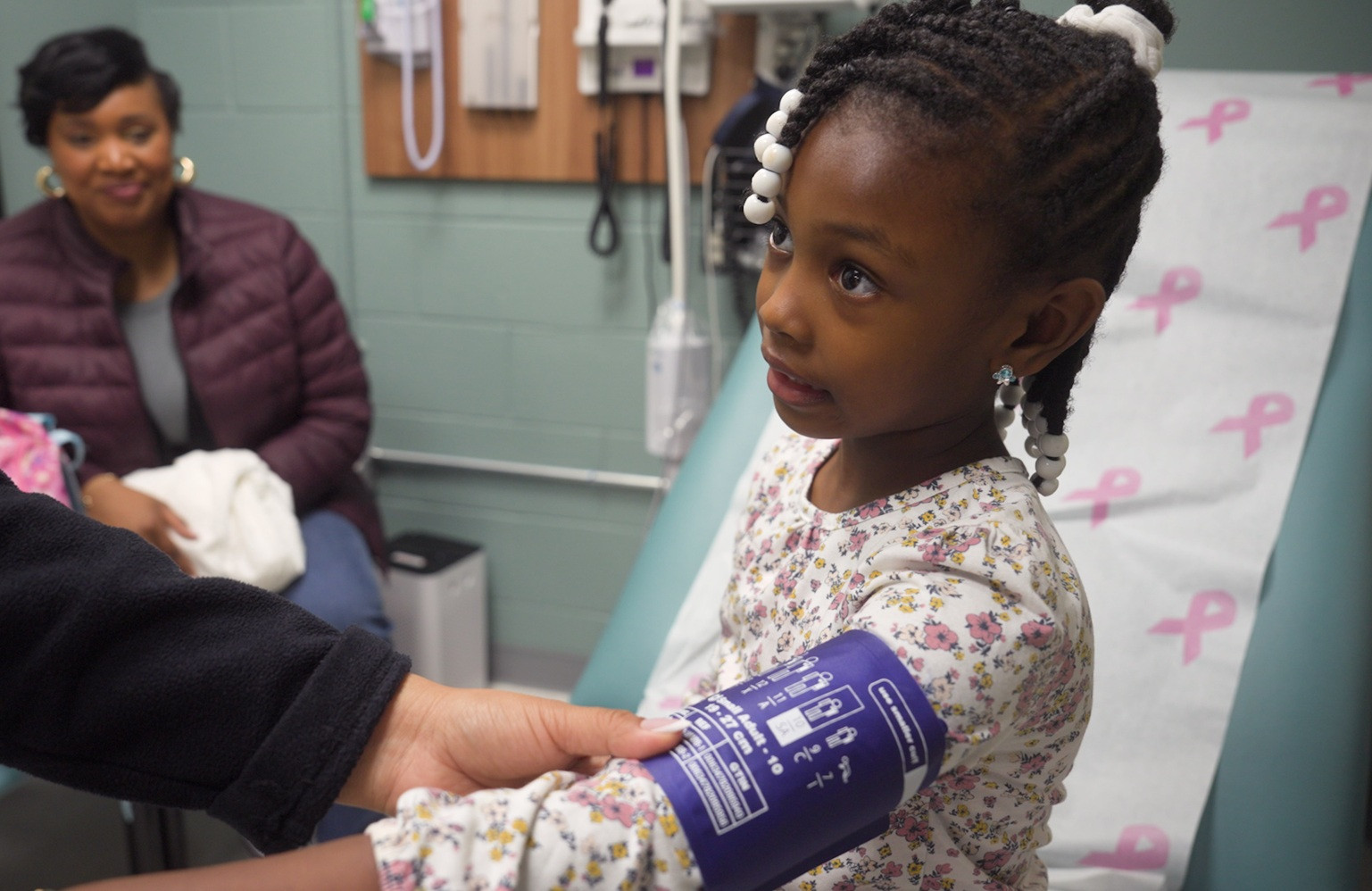
Every weekday morning in the Ironbound section of Newark, the waiting room of a St. James Health location on Lafayette Street fills with patients who, not long ago, might have had nowhere to go but the nearest emergency room.
Instead, they’re booking primary care visits, seeing specialists in small exam rooms carved out of the former outpatient clinics of St. James hospital and getting help with some of the social determinants of health — food, transportation, rent, utilities — that often decide whether a treatment plan actually sticks.
CEO Nicole Fields said her four federally qualified health centers across the city annually care for just under 10,000 patients making just under 32,000 visits. She credits RWJBarnabas for a big assist.
“We know the need in the community is there,” she said. “Our biggest problem is space.”
The partnership with RWJBarnabas Health helped St. James open its most recent site (at East Side High School in 2024), which served as the group’s biggest vaccination and testing site during covid.
It also is helping to greatly increase the size of facilities at 555 MLK Boulevard and 604 Market Street.
Fields said the expanded footprint will mean expanded services and infrastructure – not only adding vitally important OB/GYN and cardiology coverage but getting onto the EPIC digital records platform which has proven to dramatically improve coverage and cost of care.
The relationship is a health care success story. But it also is one that is dependent on essential funding from the state.
Gov. Mikie Sherrill, who made her budget address last week, warned that all state spending is under review. For clinics such as St. James, the fear is simple: An era of expansion could turn into an era of retrenchment.
***
Balpreet Grewal‑Virk, a senior vice president for community health at RWJBarnabas Health, said state support plays a large role in everything the system does. It has from the start.
When RWJBarnabas Health first started sitting down with community advisory councils in 2023, they kept hearing the same story: “People were falling through the cracks because they have so many other issues going on in their lives related to disparities or social terms of health,” Grewal-Virk said.
RWJBarnabas Health’s answer was to build — and provide the funding for — a statewide network of community health workers, a force of 80-plus that started at Newark Beth Israel but has extended to eight different counties, across the system’s 12 acute care hospitals.
These workers are the system’s inpatient spaces, embedded with federally qualified health centers, part of the New Jersey Reentry Corp and even at Newark Penn Station.
“To help the folks that are unhoused,” Grewal-Virk said.
Their work extends into almost every aspect of daily life, not only scheduling the next appointment but doing what really matters: ensuring the patient has a way to get there through the system’s initiative with Uber Health.
RWJBarnabas Health has served more than 158,000 patients in the Uber Health program alone, Grewal-Virk said.
“We want to keep replicating this all over the state,” she said.
***
Grewal‑Virk said the success of RWJBH’s community health programs is based on its ability to look beyond the hospital and into the home.
She argues that the traditional model — treat and discharge — doesn’t work for patients who leave with a prescription but don’t have a ridge, a safe place to heal or a way to navigate the system.
This is part of a systemic model for sector failure, Grewal-Virk said.
“No matter where you look in the country, the burden on emergency departments is quite significant,” she said.
She described the efforts to solve the issue of patients who are sent home — but don’t have a home to go to.
“We’re putting funds into rooms within Newark to house these folks until they are well enough to move on to hopefully something more stable,” she said. “If we just take care of them in the hospital and say, ‘See you later,’ they’re going to back to the streets and they will be right back in here in a couple of days.”
Grewal-Virk understands times are tough. But her pitch to policymakers — even with federal cuts to Medicare and Medicaid coming — is simple.
“Instead of decreasing any of these resources, we should be doing the opposite,” she said.
***
For Fields, the impact of budget cuts is easy to describe.
“We’re not opening two more sites with expanded services — and the services we offer at the four we have, will be reduced,” she said.
In addition to increases in OB/GYN and cardiology, Fields said St. James would like to add a much needed but hard to find endocrinologist.
“That’s a huge problem with our referrals,” she said. “We can’t get our patients into an endocrinologist, and it’s a huge need. Those kinds of services obviously wouldn’t happen without the appropriation.”
Then there’s this: Fields is worried about the psychological impact cuts would have on the staff, not just the community.
“If we don’t have a place to refer patients when we do get a positive screening, it really defeats the purpose,” she said.
“Doctors are devastated if they find somebody with stage one cancer, they can’t make the referral because they’re uninsured or Medicaid and we don’t have the network and the patient goes to stage four.”
Fields said the impact of their work cannot be overstated.
“It is really important to make sure our state policymakers see the incredible work we are doing and know that their investments are making a tremendous difference,” she said.


