


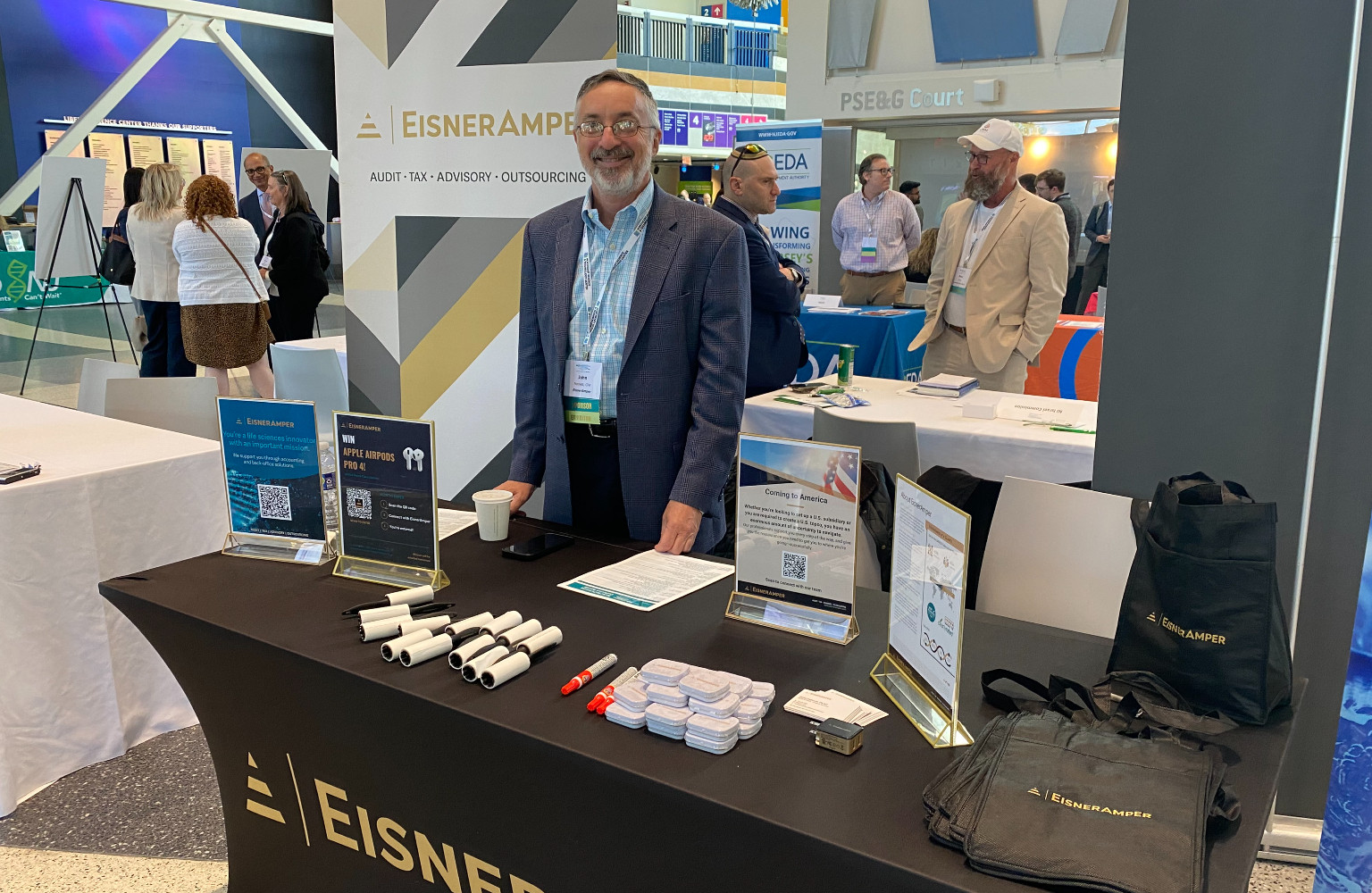
EisnerAmper’s John Pennett has been around entrepreneurs long enough to spot a trait
that seems universal: They are thinking about the finish line but not the journey toward
it.
“A lot of founders, especially scientifically oriented founders, are thinking about the
science and not the business side,” he said. “Our skill set, as financial people, is to help
them think about the journey and what it will take to ultimately be successful.”
More from the BioNJ Partnering event:
- At BioPartnering event, N.J. shows its depth — and ambition — amidst challenges
- How Coriell is building on its federal legacy with a push into commercial science
- From formation to exit, how Withum maps financial journey for life-science companies
- Founders see the finish line — EisnerAmper’s Pennett pictures the path to get them there
That’s where Pennett — the partner-in-charge of the Technology and Life Sciences
practice at Eisner Advisory Group — and his team come in.
And it’s why he was staffing a booth Tuesday at BioNJ’s BioPartnering event at Liberty
Science Center.
“We support entrepreneurship,” he said. “There are a lot of great entrepreneurs here,
and if we can help them on their journey, we’re happy to do that.”
Participating means walking founders through the journey, Pennett said.
“It’s ideation, R&D, trials, scaling,” he said. “You need support along that journey.”
Especially life science companies, where the timelines may be longer, the capital needs
larger and the technical hurdles higher, Pennett said.
That’s why, when Pennett meets a young company, the first thing he looks for is
whether they’ve thought beyond the experiment in front of them.
“They need a longer-term vision,” he said. “Not just ‘I want to build a product,’ but what
it’s going to take to accomplish that objective.”
That includes the unglamorous but essential decisions: What type of company should
you form? How should your cap table be structured? How do you protect yourself —
and your cofounders — from tax consequences later?
Pennett said too many founders wait until the end — sometimes literally the week
before a sale — to bring in professional help. That’s when the problems surface. “At the
very start, you need to set up the right type of company,” he said. “If you fix the cap
table right before you sell, the tax cost can be enormous.”
He offered a simple example: issuing a cofounder 10% of the company.
“You can do that in a way that’s taxable today or tomorrow — at zero dollars or at
millions,” he said.
“How you structure it can be very beneficial — or not beneficial — to the parties
involved.”
Beyond structure, Pennett said founders need to remember one thing: it’s other
people’s money. Whether it’s grants, angel checks or venture capital, investors expect
stewardship.
“You need books, records, processes and controls,” he said. “They don’t have to be
elaborate, but you need to take care of other people’s money and give them confidence
you’re managing it properly.”


