


The Coriell Institute for Medical Research, founded in 1953 in Camden by virologist Dr.
Lewis L. Coriell, has long been known as one of the world’s premier independent
biobanks — a place where breakthroughs in aseptic cell-culture techniques and
cryopreservation helped enable the first successful efforts to grow the poliovirus in a
lab.
Simply put, it was a foundational player in the step toward the polio vaccine.
More from the BioNJ Partnering event:
- At BioPartnering event, N.J. shows its depth — and ambition — amidst challenges
- How Coriell is building on its federal legacy with a push into commercial science
- From formation to exit, how Withum maps financial journey for life-science companies
- Founders see the finish line — EisnerAmper’s Pennett pictures the path to get them there
Seven decades later, Coriell is still a global player in government-backed science. But
with two major milestones — the launch of the Camden Cancer Research Center in
2023 and its selection as a state-designated Strategic Innovation Center in 2025 — the
institute is pushing into something new: commercial work.
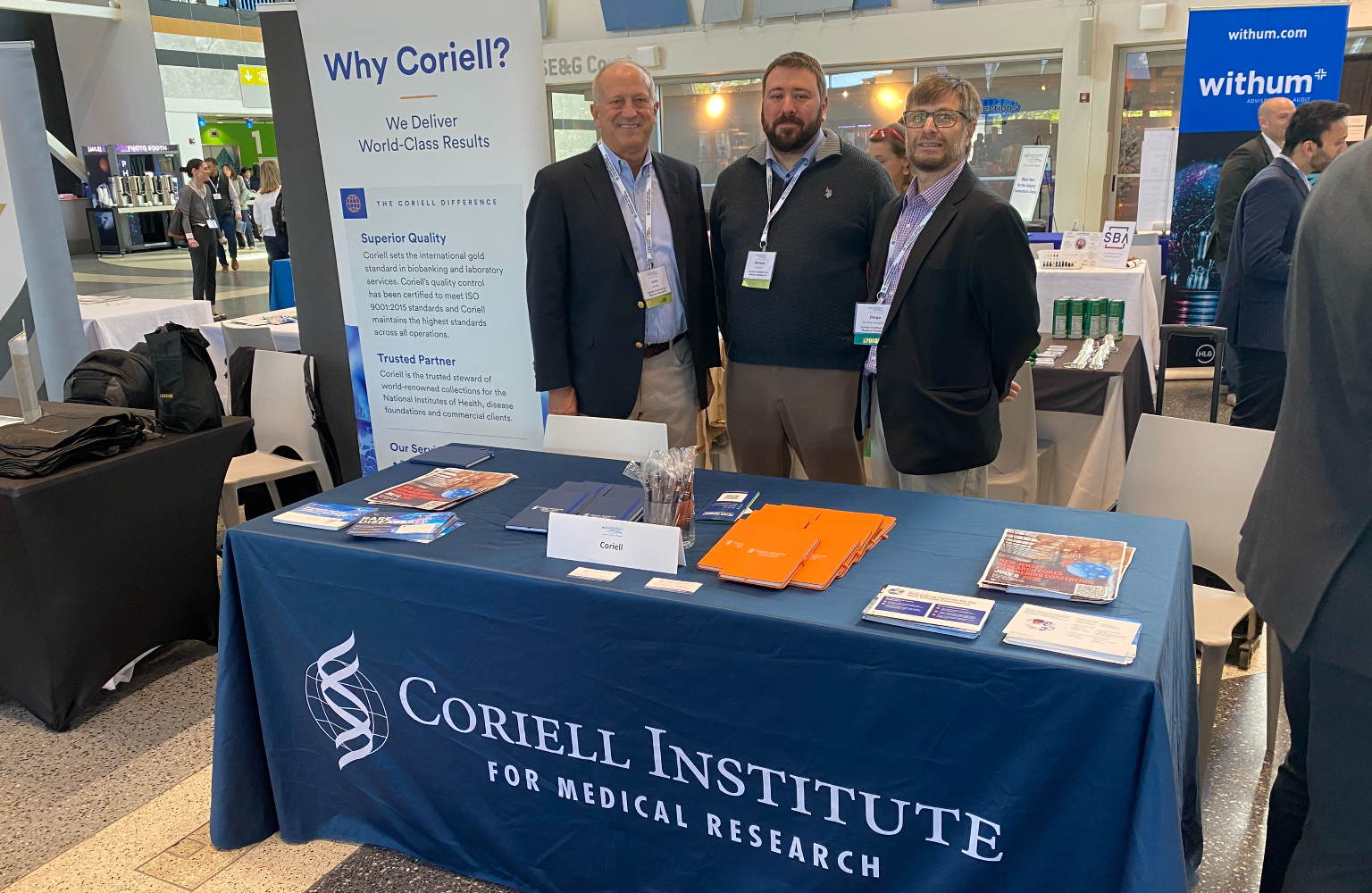
That’s why Coriell set up a booth Tuesday at BioNJ’s BioPartnering conference at
Liberty Science Center, where nearly 600 attendees, including 85 company presenters
and 77 investors, filled the building.
Trustee John Apathy put the pitch simply: “We’re expanding into commercial services —
everything around cell engineering, from collection to storage to distribution,” he said.
Will Rogers, the Director of Business Development, added the business case.
“If you’re a startup, time and resources always will be your biggest challenge,” he said.
“Spending $100,000 on building freezers and paying individuals to do inventory is a lot
of money to put into one particular need. If you’re a startup, you have a lot of other
things that you need to take care of. We can take care of this for you — we’ve been
doing it for seventy plus years.”
Here are 11 things we learned about Coriell Institute’s next chapter, based on a quick
conversation with Apathy, Rogers and Diego Morales Scheihing, the Director of Labs
Operation and Innovation:
11. Coriell’s roots run deep — and still matter today
Leaders noted that Dr. Coriell’s early breakthroughs in cell preservation still shape how
modern biobanking is done — a reminder that the institute’s legacy isn’t just historical,
it’s operational.
10. Government contracts remain the backbone
Apathy acknowledged that NIH repositories still make up the majority of Coriell’s work,
describing them as “long-standing programs that anchor everything we do.”
9. Coriell is now pushing hard into commercial services
Apathy said the institute is “rebooting” its commercial strategy, aiming to supply
everything around cell engineering: collection, storage, measurement, quality and
distribution — a shift he described as overdue.
8. Startups are a major target
Rogers said early-stage companies often underestimate the cost and complexity of
proper storage. “It’s not just buying a freezer,” he noted — it’s monitoring, redundancy,
and 24/7 protection.
7. Private biobanking is a growing business line
Apathy said foundations and rare-disease groups increasingly want specialized sample
collections — and Coriell can build and manage those banks end-to-end.
6. IPSC generation is becoming a specialty
Rogers explained that induced pluripotent stem cells are in high demand, especially
among startups without the infrastructure to generate them. Coriell sees this as a major
growth lane.
5. Cryopreservation is a science — and a risk if done wrong
Rogers pointed out that even small mistakes — like warming a glass vial too quickly —
can destroy samples, ruining hundreds of thousands of samples. “There’s a reason
people come to us,” he said.
4. Coriell’s reach is global
Rogers said the institute routinely receives samples from around the world, including a
recent request from Australia.
3. The Strategic Innovation Center will reshape its footprint
Rogers said the designation will allow Coriell to host startups, expand services and help
build what he called “an innovation center for the East Coast,” with companies cycling in
and out as they grow.
2. NIH funding cuts are a concern — but Coriell is holding steady
Morales Scheihing said some programs were at risk during federal budget uncertainty,
but they ultimately deemed essential. Coriell recently secured a major new NIMH
contract.
1. The goal for Coriell is simple — be known as more than a government partner
Apathy summed it up this way: Coriell wants to be seen as a research provider for both
government and industry — especially startups that need a trusted partner to handle
their most valuable material.


