


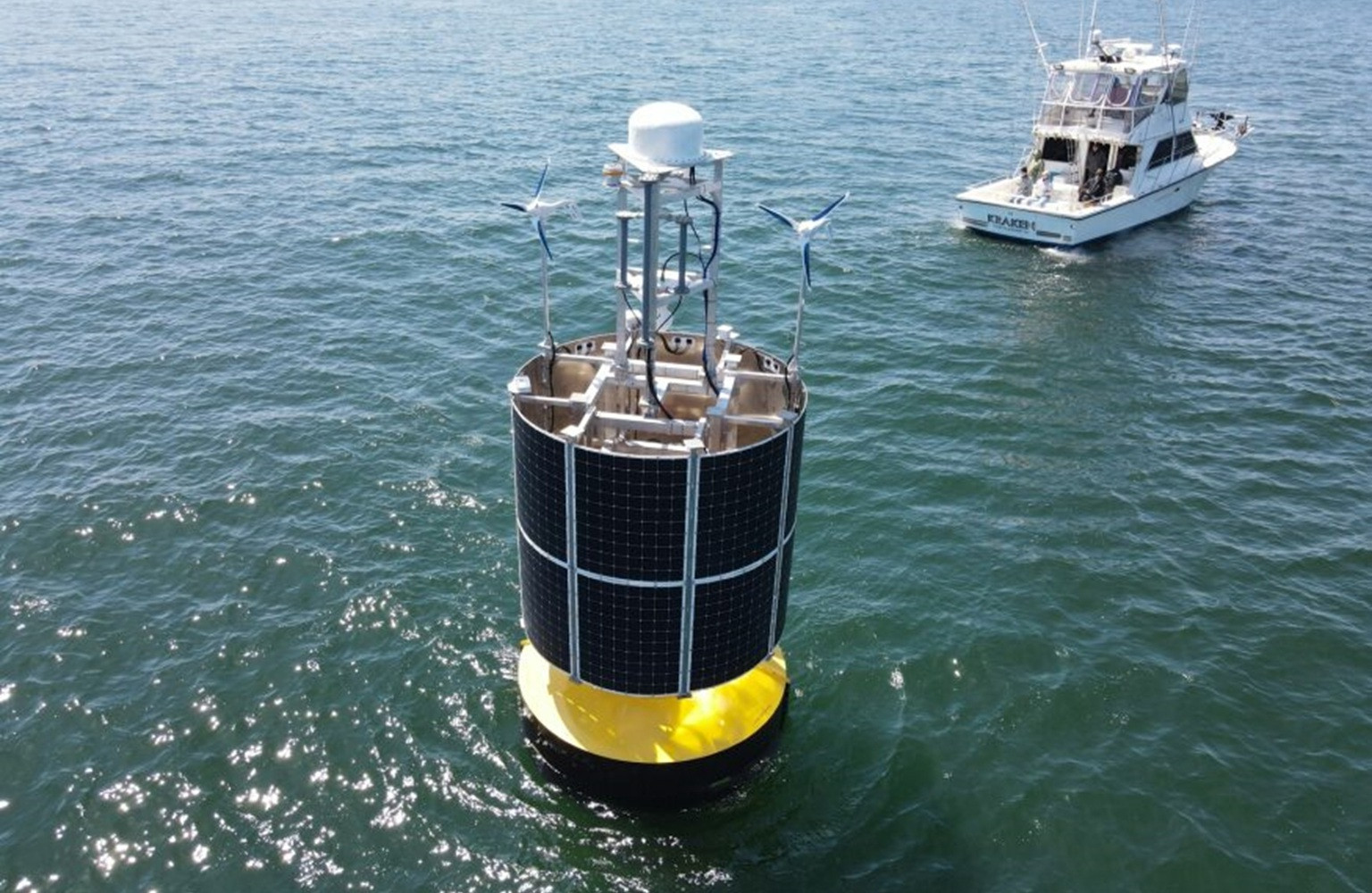
A groundbreaking partnership between Rutgers University, Stockton University, the New Jersey Economic Development Authority (NJEDA), and Ocean Power Technologies (OPT) was recently announced, aimed at reviving the historic Long-Term Ecosystem Observatory (LEO) off the Jersey Shore.
The initiative marks the “rebirth” of a pioneering program that first put New Jersey at the forefront of marine science in the 1990s.
By integrating Stockton’s near-shore expertise with Rutgers’ global leadership in ocean observation, the collaboration seeks to position the state as a dominant hub for the modern “blue economy.”
The centerpiece of the revitalization is the scheduled deployment of OPT’s PowerBuoy in early 2026. This high-tech research buoy will be anchored three miles off the coast of the Rutgers Marine Field Station in Tuckerton at the historic LEO site.
Powered by renewable solar and wind energy, the PowerBuoywill function as a floating data hub. Unlike traditional monitoring systems, it provides:
-
Real-time Data: Continuous tracking of ocean temperatures, currents, and salinity.
-
Plug-and-Play Ports: Access for guest scientists to connect their own specialized instruments.
-
Autonomous Operations: Long-duration monitoring with a minimal surface footprint.
“The PowerBuoy is set to usher in a new era of marine and coastal research and it will be a critical element in the rebirth of LEO,” Josh Kohut, dean of Research, Rutgers School of Environmental and Biological Sciences said.
The original LEO-15 program, launched in 1996, was one of the first systems in the world to use cabled seafloor nodes in 15 meters of water to study fish ecology and coastal storms. The new system replaces aging cabled infrastructure with wireless, renewable-powered technology, ensuring the site remains a cornerstone for coastal science.
A key priority of the NJEDA and its academic partners is leveraging this infrastructure for workforce development. Stockton University will use its R/V Petrel and Marine Field Station to provide students with hands-on hydrographic surveying experience.
“The proximity of LEO to Stockton’s programs creates incredible opportunities for students,” Steve Evert, director of Stockton’s Marine Field Station said. “They’ll gain experience that translates directly into workforce readiness.”
Beyond academia, the project provides a testing ground for blue-tech startups to develop solutions for coastal resilience and sustainable marine growth. “This partnership highlights how government, academia, and industry can work together to strengthen ocean science and accelerate innovation,” Philipp Stratmann, CEO of Ocean Power Technologies said.


