


With a total enrollment of more than 50,000, more than 150 majors, and nearly $1 billion in research funding, Rutgers University seemingly has it all. And it’s no wonder the school was recently ranked as the No. 16 public university in the country — and No. 42 overall.
But to think this mammoth institution can survive and thrive on its own would be a mistake. For the university to truly prosper as a whole — and as an instrument for societal good — Rutgers must be completely integrated into the business, government, and educational communities in which it lives.
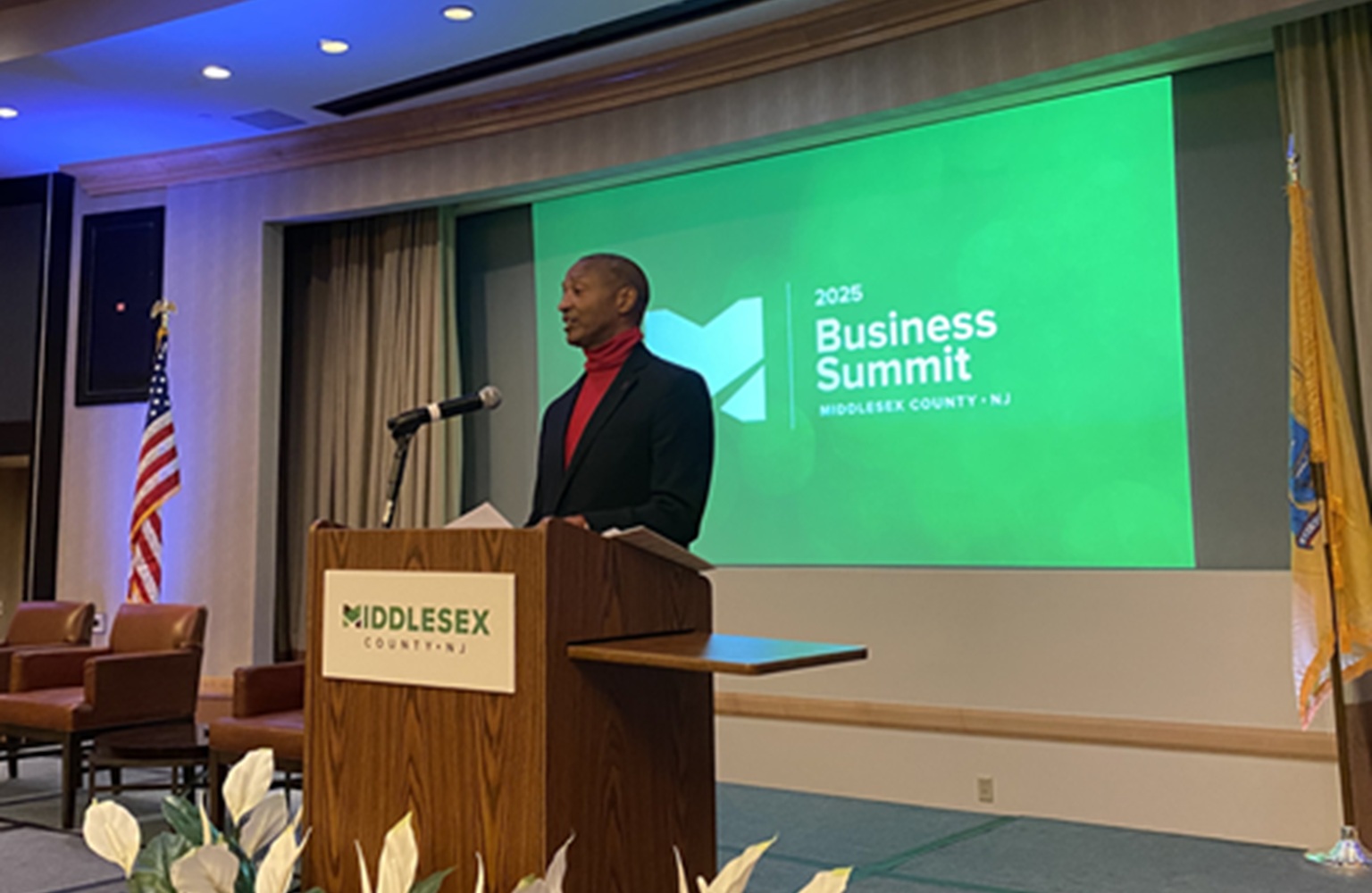
So said William Tate IV, its new president, during the keynote address at the annual Middlesex County Business Summit at the Heldrich Hotel in New Brunswick.
“Organize or die,” he told a group of more than 500.
Tate described the cycle of opportunity that he has seen throughout his career when educational entities did — or did not — have a connection to the communities in which they were located.
He described how, when he was a young math teacher in the greater Dallas region, he wondered how so many grade schoolers could be falling behind in the subject even though they were located inside a tech bubble of the highest order. Simply put, the educational system lacked meaningful connectivity to the surrounding tech ecosystem.
He described how, during his time as vice provost for graduate studies at Washington University in St. Louis, the school joined with Saint Louis University and Barnes-Jewish Hospital to create the Cortex Innovation Community — a 200-acre research hub that not only redefined health care education and research in the area, but also helped revitalize a community that was the definition of underserved and underutilized.
He described how, during his presidency at LSU, the school collaborated with other higher education institutions in the state to secure a massive grant for energy — and that, after doing so, realized the value was not in developing new energy but transforming energy infrastructure.
Tate told the audience he has spent a lifetime seeing how organizing with others leads to a greater good for all.
He’s eager to bring that spirit to Rutgers and to help it grow the relationships it already has, particularly in the life sciences sector, Tate said.
Tate noted the school already has seven active research agreements with county-based companies, 12 licensing partnerships with businesses in the county, and that the county is home to 17 Rutgers-born startups.
“That’s extremely important,” he said. “It’s important that Rutgers never be a closed system and always an open system.
“And if we do that at scale, it will be more than just theoretical. It will translate from molecules to the market to the best biomedical ecosystem in the country.”
Tate said his aim is to make New Brunswick the No. 1 life sciences market in the country, surpassing Dallas, Silicon Valley, and Austin, Texas in the process.
But don’t be confused. Tate said he is about more than just STEM education. He gave a salute to the studies of humanities — noting how they produce more jobs than STEM — and detailing how all graduates, working together, are the key to a greater good.
Tate said he is proud that Rutgers-Newark and Rutgers-Camden were both ranked in the Top Ten nationally for social mobility in the recent U.S. News rankings — and that Rutgers-New Brunswick was second in the Big Ten.
“Rutgers is in a human capital business,” he said.
And it’s not in it by itself.
The school must work with the K-12, magnet, and charter schools in Middlesex College, he said. It must work with the local and global businesses in the area. And it must work within Rutgers itself — determining how life science research can partner with areas of the university that are experts in law and business, he said.
It’s all part of what Tate called the cycle of opportunity for all.
“The job of Rutgers is to benchmark the very best practices, so they can be applied in the open system with colleagues like yourselves who work in industry — and we work together,” he said.


