


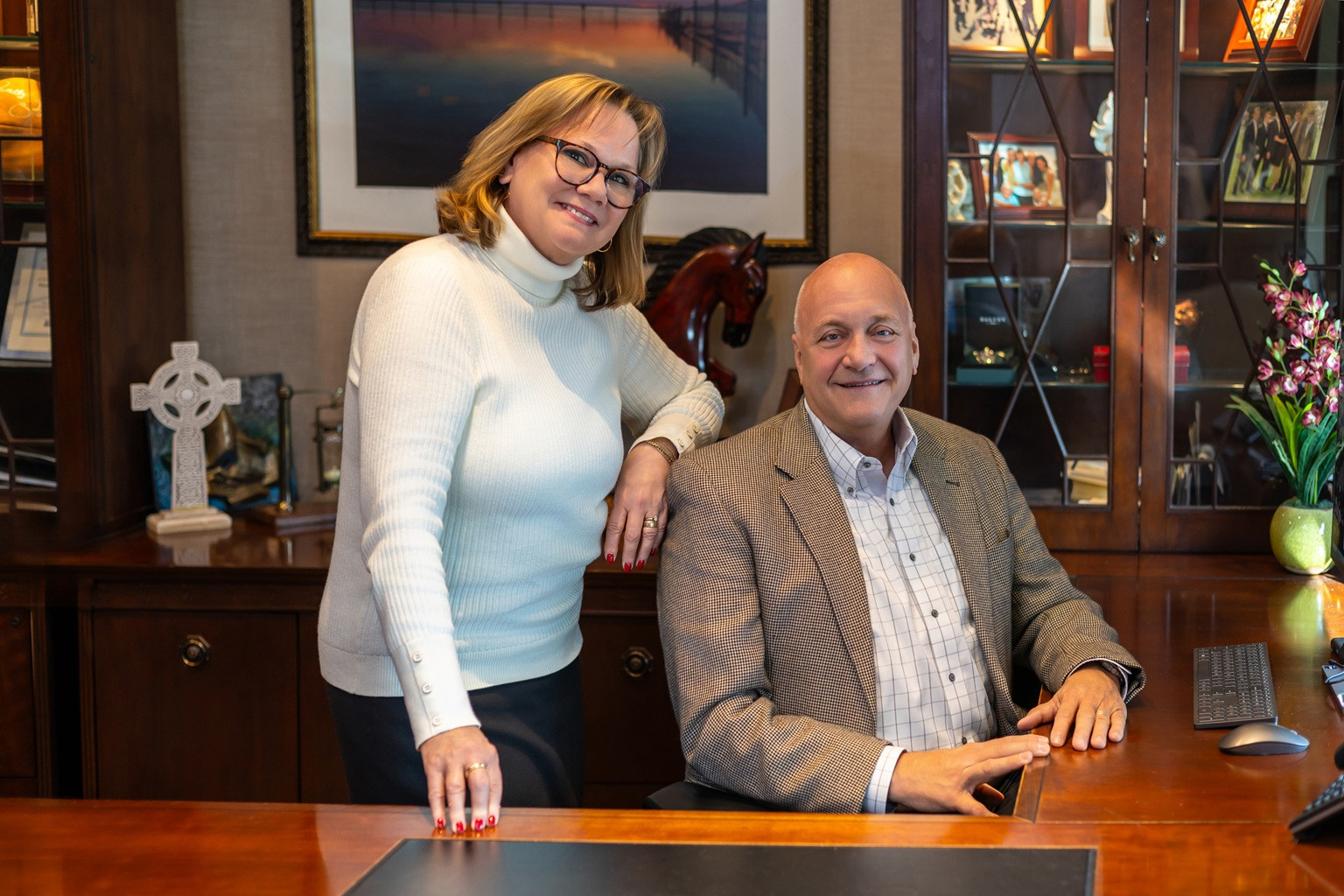
It was never a spoken word. Just a quiet tap on the shoulder.
That’s how Mike Maron, CEO of Holy Name Medical Center in Teaneck, would apologize to Nancy Bischoff, his top assistant of 36 years.
After a disagreement — sometimes heated, sometimes petty but never long-lasting — Maron would emerge from his office, walk past Bischoff’s desk, and gently pat her shoulder. No words. Just a gesture. And she’d know: He had come around.
“That’s his way of saying, ‘Sorry,’” Nancy said with a laugh.
“And it was a daily occurrence,” Maron added.
It’s the kind of shorthand that only comes with time and trust. With a relationship that’s outlived four previous assistants, decades of health care upheaval and more than a few arguments.
It’s one that came to an end last week when Bischoff retired.
Maron, in a note to the staff, tried to sum up what Bischoff has meant to him.
“Nancy’s professionalism, loyalty, and calm command have shaped and supported daily life for leadership across generations,” he wrote. “She’s been a constant presence through change, challenge, and triumph — a steady voice of reason and reassurance, and an unfailing example of what it means to serve with integrity and heart.”
Theirs is a blast-from-the-past type of relationship that’s unfortunately vanishing from the modern workplace.
***
Bischoff started at Holy Name in 1977, fresh from an accounting job in Teaneck and a few years after her high school graduation.
She was from Bergenfield, a local hire with no grand plan — just a willingness to work hard. After four assistants failed to keep pace with Maron, Bischoff stepped in. And stayed.
“We clicked right away,” she said.
The relationship grew as they did.
“We both had kids the same age, so we were going through the same things,” she said. “We understood each other’s work-life balance.”
That balance became the bedrock of their professional rhythm. Maron describes it as a “natural cadence.”
Bischoff could read his mood before he spoke. When she knew when he wasn’t listening, she’d repeat herself — twice, three times — until she knew he’d heard what he needed to hear. And when he needed a gut check, she was the one he turned to.
“She’s been my eyes and ears,” Maron said. “She’ll tell me the truth. Most people who come to see me are blowing smoke up my skirt. Nancy doesn’t.”
It’s a relationship from a different era – one that feels similar to popular TV shows from the time Bischoff started: M*A*S*H and The Mary Tyler Moore Show.
Maron calls Bischoff his Radar O’Reilly, because she was on top of everything. And while he was the boss, their relationship mirrored the closeness between Mary Richards and Lou Grant.
“He is my boss; he has mentored me – but more than anything, he’s my friend,” Bischoff said.
***
The bond between Bischoff and Maron is rarely found in the workplace these days.
Assistants are often transient. Executives cycle through roles. Loyalty is measured in quarters, not decades. And the idea of a boss confiding in a colleague — venting, arguing, debating and still showing up the next day with mutual respect — seemingly is only found in a movie.
Or at Holy Name, where long-term employees are the norm, not the exception.
“Our relationship represents the culture at Holy Name,” Maron said. “We think it’s something leaders across every industry should refocus on. We’ve become too transient, too digitized, too AI-focused. We’ve lost the human interaction that shows conviction and loyalty — and does it on a two-way street.”
It comes with opportunity for growth, too.
Bischoff’s role wasn’t just administrative. She was also the hospital’s patient advocate, fielding calls and complaints, connecting dots, and making sure Maron knew the good, the bad and the ugly.
Bischoff didn’t just manage Maron’s calendar — she managed his conscience.
That part of the friendship, forged in the crucible of shared purpose, is what Maron said he will miss most.
“It can be incredibly lonely at the top,” he said. “You don’t always have someone you can confide in. I do.”
Holy Name remains one of the few independent hospitals in New Jersey. And Maron credits its longevity to that culture.
It’s a culture built on relationships like his and Bischoff’s. On colleagues who’ve been there for 30 years. On assistants who aren’t afraid to say, “You’re 100 percent wrong.” And on leaders who are willing to hear it.
“It’s our greatest asset,” Maron said. “It gets us through the hard times and lifts us in the good times.”
***
Bischoff’s successor, Kathleen Reilly, has worked at Holy Name for three decades. She’ll inherit the desk, the responsibilities, and maybe even the shoulder taps. But the relationship? That’s irreplaceable.
“When I tell people how long I’ve been here, they can’t believe it,” Bischoff said. “No one has this type of situation at work anymore. But we did.”
Her friends and family call it “Holy Nancy Medical Center.” And for good reason.
“I love every inch of this place,” she said.
The cadence, however, has shifted.
When Maron walked into the building this week, there was no one there to read his mood. No one to say, “You’re not listening.” No one to tell him he’s wrong — and be right.
But the culture they built together will carry on.
“Our relationship is like husband and wife, brother and sister, lifelong friends,” Maron said. “We can laugh, we can cry, we can argue — but we both know it comes from a place of mutual respect and love.”
That’s the legacy of Mike Maron and Nancy Bischoff.
It wasn’t about a career but a connection. And in a work world that’s forgotten how to build them, maybe it’s time we all remembered.


