



In the middle of the party period in which the motion industry celebrates its successes
— capped, of course, last night by the Oscars — a leading executive at Netflix recently
made a metaphorical request of the drivers of the industry in New Jersey: Stop buying
us drinks.
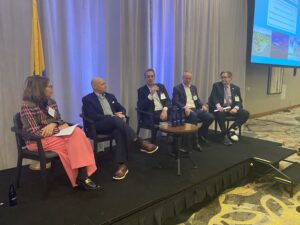
Nick Maniatis, director of studio and production policy for Netflix in U.S. and Canada, said New Jersey must resist the temptation to continually increase its incentives to keep
pace in a race among states for business.
Maniatis made the plea earlier this month at the New Jersey Bankers Association’s annual Economic Forum event — and he did it as part of an all-star panel from the
industry that described how the New Jersey Film & Digital Media Tax Credit Program has been the biggest driver behind the massive growth of the industry in recent years.
“We want (the industry’s presence in New Jersey) to be solid, right?” he asked an overflow audience and then answered. “We don’t want you to give us too much, so that you have to come take it away. We want it to be consistent. And I think the state has really done a good job with that.”
Maniatis has made the request before, leading some to suggest that Netflix — which is
only able to build its approximately $1 billion studio in Eatontown/Oceanport because of
incentives — is trying to keep potential competitors out.
But Maniatis, who was once New Mexico’s film commissioner, said it’s just the opposite. Maniatis said he is making the request to stabilize a now‑mature market.
“We’ve gotten in trouble because people think we’re against having more people come,”
he said. “We’re not. We want more people to come. But they keep asking for more and
more, and when you ask for too much, the program suffers.”
Right now, the state’s ability to attract the sector is unquestioned. Netflix is just one of
three major studios being built (see LionsGate in Newark and 1888 Studios in
Bayonne). Even without them, the state has used the incentives to increase revenue in
the sector from a little over $500 million just a couple of years ago to projections of more
than $12 billion in production spend within the first five years of the fully formed
program.
In Maniatis’ view, film incentives that are pushed too far become politically fragile and
thus easy targets in bad budget years. That instability can undercut the very growth
New Jersey is trying to lock in, he said.
He pointed to Michigan as a cautionary tale, where too many incentives eventually
doomed the industry for everyone — with the state closing its incentive program
completely in 2015.
“If it doesn’t work for the state, then it doesn’t work for anyone,” he said.
That sober assessment came in the middle of what was otherwise a celebration of New
Jersey’s film renaissance during the panel.
Jon Crowley, head of the New Jersey Motion Picture & Television Commission, laid out
just how far the state has come in a short span, saying the state will have done more
than $1 billion in business in 2025, once everything is counted.
The trend in 2025 was even more telling, Crowley said.
“New York was down. Georgia was down. New Mexico was down,” he said. “New
Jersey was the only one that was up.”
That doesn’t happen by accident.
CSG Law attorney Eric Brophy, who served as deputy chief of staff in the Murphy
administration, said the former governor saw the industry as a way to quickly create
economic growth. Film and digital media were central to that effort.
With help from First Lady Tammy Murphy’s entertainment‑industry relationships, New
Jersey rebuilt the Film & Digital Media Tax Credit to be competitive with states such as
Georgia and New Mexico — but with an important twist: the program rewards
brick‑and‑mortar investment, not just fly‑in, fly‑out productions.
That design is part of what drew Netflix to Fort Monmouth.
Maniatis recounted how, in 2019, he was tasked with finding an East Coast hub and
looked at eight states, including Illinois and Virginia, before a conversation with Murphy
and his team changed the trajectory. What impressed him wasn’t just the rate of the
credit, but the way it was structured, he said, with a push for actual studios — which
help the economy in a different way.
The presence of a billion‑dollar studio project pulls an entire ecosystem along with it:
hotels, restaurants, hardware stores, electricians, carpenters, caterers, wardrobe
houses, lumber yards.
The state has tried to match that momentum with workforce and local‑government
initiatives: a $5 million training push with unions and schools, and a “Film Ready”
program to standardize permitting across hundreds of municipalities.
Together with the tax credit — now extended to 2049 — New Jersey is betting not just
on more shoots, but on long‑term, middle‑class careers.
Which brings us back to Maniatis’ unusual ask.
At a moment when other studios and some states are still pressing for bigger subsidies,
Netflix is effectively telling New Jersey: Don’t chase the highest number; protect the
program.
“That’s why the last couple of sessions, we’ve been fighting against increases to the
credit, much to other studios’ chagrin, because we want this to be a long program,” he
said. “We’re putting a billion dollars into the state just to build our studio, let alone the
cost of bringing all our productions here. And we want this to be a solid, well-thought-out
consistent program that returns for you and returns for us.”


