


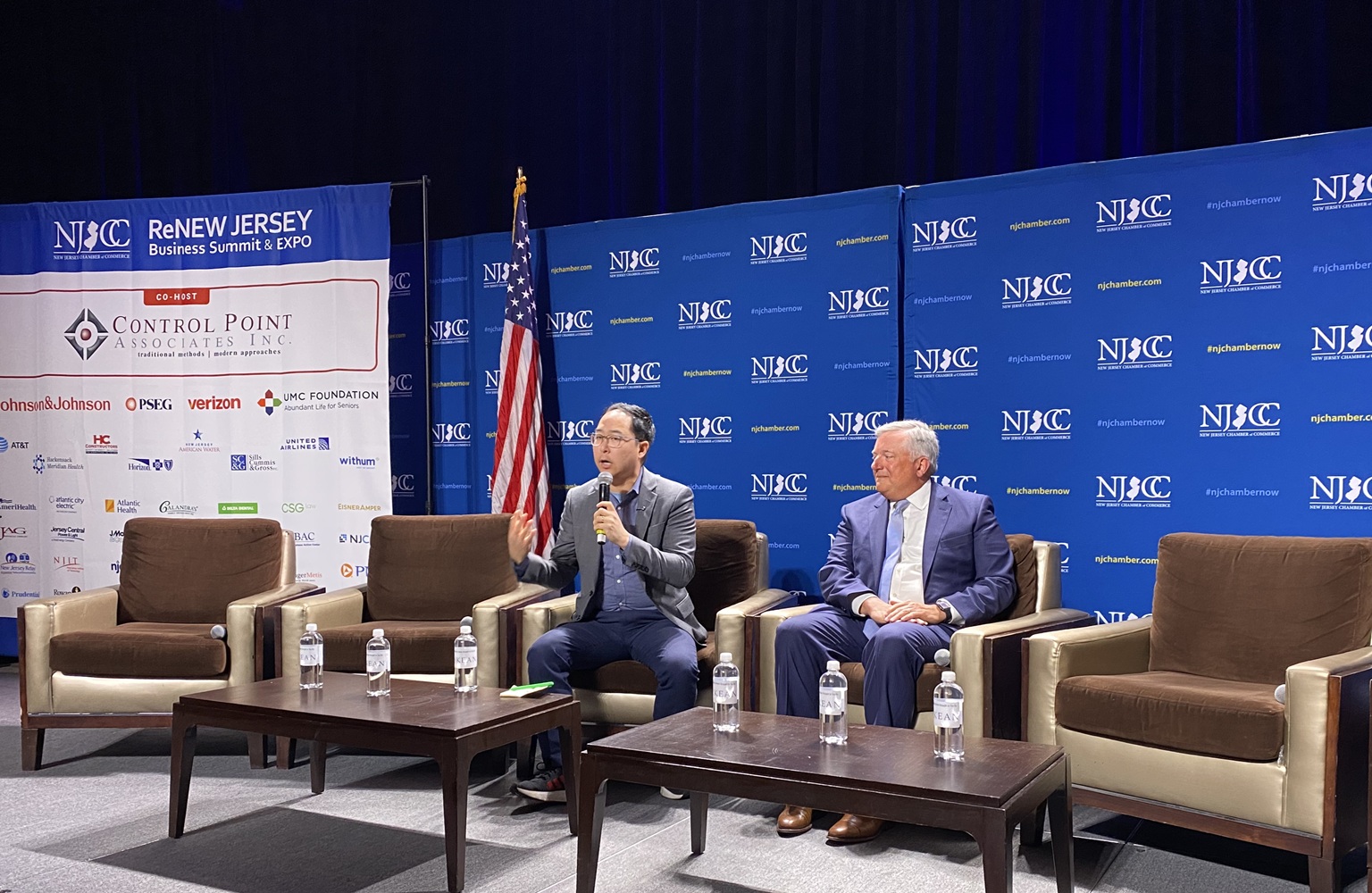
Sen. Andy Kim told the audience at the ReNew Jersey Business Summit that the CHIPS and Science Act, a bipartisan effort to strengthen the country’s high‑tech manufacturing and research base, is exactly the kind of long‑term industrial initiative New Jersey needs to tap into.
Then he delivered this stunning stat.
“We have this big investment,” he said. “How much of that money came in New Jersey so far? Zero.”
The revelation was the type of constructive conversation the Summit aimed to spur.
Kim, appearing Tuesday in a session with Neil Bradley, the chief policy officer and head of strategic advocacy at the U.S. Chamber of Commerce, didn’t hold back on his thoughts.
Kim said he sees CHIPS as a model for how Washington can approach critical sectors such as semiconductors, advanced manufacturing and science more broadly — and as a warning sign for New Jersey.
BINJE coverage of ReNew Jersey Summit 2026
- BINJE Poll: Affordable housing, health care top wish list of state’s business leaders
- A new audience for advocacy: Why Autism New Jersey attended the ReNew Jersey Summit
- Some like it hot: How Withum booth stole the show at ReNew event in A.C.
- Sherrill: In chaos, there is opportunity
- United CEO Kirby: I think Newark is the Crown Jewel for United Airlines
- Host Committee unveils ‘Welcome World Rewards Program’ to support small business in region
- LaRossa: State needs to get to ‘Yes’ or ‘No’ – quickly
- Results over rhetoric: Caldwell tells business crowd it’s all about getting things done
- Mobility matters: Why getting Gateway done matters to the region
- From bust to buy‑in: Guardian on why Atlantic City is now ready for competition
- Left out … left behind? Kim says CHIPS Act failure is warning sign for state
If the state can’t organize itself to compete successfully for CHIPS‑related awards, it risks missing out on what he views as a once‑in‑a‑generation wave of federal funding aimed at precisely the kind of innovation New Jersey likes to claim as its identity.
To change that, Kim said New Jersey needs to get much more intentional about its research and higher‑education infrastructure. He talked about the importance of adding more R1‑level universities in the state and strengthening the entire pipeline from lab to market. (The state currently has three RI universities: Princeton, Rutgers-NB, NJIT)
Roughly $1 billion a year already flows into New Jersey in research support, Kim said, but the real question is how to “be better at figuring out how to commercialize that and get that towards product and be able to grow businesses.”
Kim connected CHIPS directly to New Jersey’s existing strengths in life sciences, biotech, photonics and AI.
He warned that China is threatening to surpass — and may already have surpassed — the U.S. in biotech, and said states like New Jersey need to see themselves as front‑line players in that competition, not spectators. In that context, failing to land CHIPS‑related projects isn’t just a missed economic opportunity; it’s a strategic vulnerability, he said.
At the same time, Kim stressed that CHIPS shows what’s possible when Washington gets it right. He framed the law as an example of the kind of bipartisan industrial strategy he wants to see replicated in other sectors.
The task now, he said, is for New Jersey to better engage with federal agencies, align its universities and innovators, and present itself as a ready partner for the next rounds of CHIPS and science funding — so that when the money flows, New Jersey is no longer sitting at zero.
Here are five other big things Kim said during his chat with Bradley that was moderated by State Chamber CEO Tom Bracken.
5. Building an innovation “Punch List”
Kim said he’s not thinking in terms of one‑off projects, but of a true innovation ecosystem. He talked about working through a punch list of what New Jersey needs and invited business leaders to help shape it. His goal, he said, is for the state to diversify its innovation base, grow its workforce and be more competitive — not just nationally, but globally.
4. Creating more startups
Kim argued that New Jersey is one of the strongest areas in the world for photonics companies and research. He also said the state crushes it when it comes to life science. The challenge, he said, is to get better on start-ups. With about $1 billion a year in research funding, Kim said the challenge is to commercialize more of it into products and companies here, not somewhere else.
3. Quality of life vs. affordability
Kim noted that New Jersey ranks No. 3 in the country on quality of life — a big asset in recruiting talent and companies. But he said that advantage is undermined by other challenges of affordability, including health care and housing (a view shared by eventgoers).
New Jersey’s long‑term competitiveness depends on pairing its quality‑of‑life edge with a more predictable, affordable environment for both families and employers, Kim said.
2. Permitting reform
Kim highlighted a bipartisan housing bill he co‑wrote with Republican Sen. Mike Rounds that included the first bipartisan piece of permanent reform in some time. Kim called it “a step in that right direction” and a “confidence building measure.” The point, Kim said, is to show that permitting reform can be done together — and then extend that model to housing, energy and broader economic development, where companies complain that it still takes too long to get shovels in the ground.
1. Long-term commitment
Kim reminded the audience that he was sworn into the Senate at 42, and that — if voters keep him there — he could potentially be there for a quarter century and still be younger than the current average senator. He said he doesn’t just want to help sketch a vision for where New Jersey can go, he wants to see it through. The questions that guide him: “What kind of New Jersey do I want for my kids when they’re my age?” he said.


