


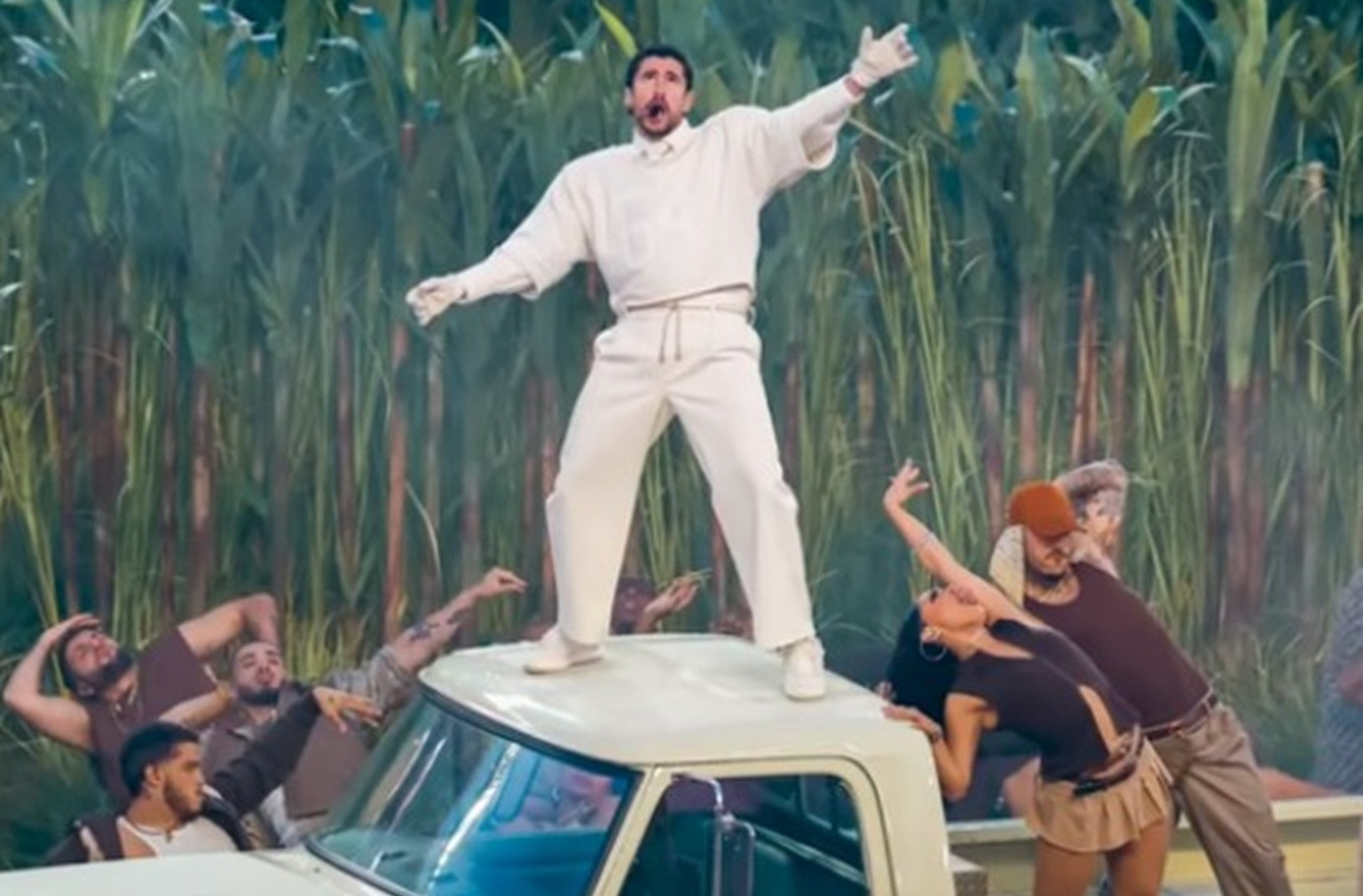
Let’s start with this: Bad Bunny is an American Citizen.
Let’s skip over the fact that so many previous performers during the halftime show of the Super Bowl — a truly All-American moment — have not been American citizens (U2, The Who, The Rolling Stones, Paul McCartney). Some have been non-American citizens of color (The Weekend, Rihanna). And some even, gasp, have been Hispanic (Gloria Estefan, Shakira, Jennifer Lopez).
Let’s mention this: Bad Bunny arguably has done more to help Puerto Rico recover from its Superstorm Sandy (Hurricane Maria in 2017) than the federal government. His 31-concert, low-cost residency last year, designed to bring people from the mainland to the island, did just that — creating an estimated $500 million in economic impact along with a sense of hope.
Let’s offer a civics lesson: Anyone born in Puerto Rico is an American citizen — and you don’t need a passport to travel there. (Many Americans would get this wrong.)
Let’s sum it up this way: A talented American performer (six Grammys) who has done so much to help an island that has been a U.S. territory since 1898, performed at the Super Bowl.
So … let’s take it down a notch.
Bad Bunny’s show, an incredible salute to Hispanic culture, was an All-American halftime show. Does it have to be anything more than that? Did it have to spur an alternative halftime performance by … other Americans?
Let’s break it down.
Did it offer symbolism of how the U.S. has failed the island? (Sure, those utility poles were there for a reason).
Was the little boy to whom he gave the Grammy the one who was detained by ICE? (No, that was just an internet rumor).
Did the parade of flags symbolize how many different countries make up Latin America or make a political statement? (Perhaps both).
Hispanic business leaders in the state of New Jersey watched the show with pride. They don’t always get to see the culture of nearly 25% of our state’s population on such display.
But they know it comes with a bit of fear and unease — similar to their journey as entrepreneurs, when access to capital is determined by more than their business plan. They know there likely will be as many questions about their status as the million-dollar companies so many have started.
Lori Tarke, the executive director of the Joseph A. Unanue Institute at Seton Hall University —which advances, educates and transforms students into the next generation of servant leaders in our ever-changing global society. For more than two decades, the Institute has also been working to help Hispanics better integrate into the N.J. business community and non-Hispanics improve their understanding of the American Latino market. Tarke was blown away by the performance, one she re-watched.
Part of her role at the institute is showing how cultures can integrate. She feels Bad Bunny did just that.
“Benito welcomed everyone to celebrate the culture that represents 20 percent of this country,” she said. “Then he went into reminding you to celebrate life, love and humanity.”
Tarke addressed the fact that the show was presented in Spanish, a huge issue with so many.
“When I was a child, I watched the Rolling Stones and Queen. I didn’t speak a word of English but I knew they were great. You don’t need to know a language to have music move you,” she said. “Some things are universal, like the love of life, humanity and celebration.”
Luis De La Hoz, the chairman of the Statewide Hispanic Chamber of Commerce, said the show was authentic.
“A great cultural statement, not only for Latinos in general, but indeed for Puerto Rico,” he said.
De La Hoz noted Bad Bunny was not the first Hispanic performer, but the first to perform in Spanish. He said he hoped it was a shift from “inclusion to normalization.”
By the time the 14-minute show ended, reality set in.
Aixa Lopez, a small business owner and the chief of staff at the Hispanic Chamber, applauded Bad Bunny for drawing attention to someone few want to discuss: The country’s poor response to Hurricane Maria.
“Puerto Rico’s longest blackout after Hurricane Maria in September 2017 lasted about 11 months,” she said. “Significant parts stayed dark for over four months, causing over 3,000 deaths, especially among elders and those needing medical help. Meanwhile, on the mainland, it was business as usual, and nobody cared.
“Benito created a song called “El Apagòn” describing, that in Puerto Rico there were human beings.”
Lilia Rios, also a successful entrepreneur, was thrilled by the show, but she said it comes with concerns.
“The Latin American parade represented a clear effort to amplify a political stance,” she said. “I’m concerned that instead of generating empathy and awareness as we would all hope, it ends up deepening an even greater divide — and instead of uniting, further fuels polarization and feelings of rejection toward our community.”
All this from an entertainment show during the 250th anniversary of a country created to serve as a melting pot of all cultures?
Let’s let that sink in a while.


