


The torn-up intersection on Washington Street in Hoboken didn’t look like progress — it looked like a mess. One that was rerouting traffic, causing headaches for residents and workers. One that was limiting business for the shopkeepers that lined the street.
And one that came with a unique twist.
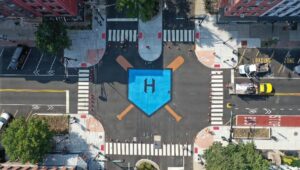
T&M Associates not only had to modernize the underground water mains and streetscape; it also had to make sure home plate and the bases were precisely restored afterward. You see, this corner marks the birthplace of baseball, commemorated by special pavers outlining an infield. Preserving that detail mattered as much as rebuilding the road.
 Gary Dahms, the longtime CEO of T&M, sees the Hoboken project as a perfect symbol for the company’s 60th anniversary. Founded in Monmouth County in 1966, T&M has grown from a small New Jersey municipal engineering firm into a national player operating in 40 states, Canada, and Puerto Rico, with regional hubs stretching from New Jersey to Ohio and offices reaching as far as California.
But even with that national footprint, Dahms, the firm’s fourth CEO, still believes the most meaningful stories start at street level.
“Everything we do ultimately shows up in someone’s daily life,” he said. “If you’re not thinking about the community first — about the people who have to live with what you build — you’re missing the point.”
This philosophy has shaped T&M’s evolution across its service areas: community and land development, environmental services, transportation, water infrastructure and buildings and facilities. It’s also central to one of the company’s defining strategic decisions: remaining independent at a time when many engineering firms are being consolidated into private equity portfolios or absorbed by global conglomerates.
T&M’s five-year plan calls for 8–9% annual growth through organic expansion and strategic hiring, not through mergers or acquisitions. Dahms is unwavering: the company is not for sale and not seeking a buyout.
“Independence gives us the freedom to think long‑term — for our people, our clients and the communities we work in,” he said.
A long-term view aligns with the work T&M is asked to do. From the Hoboken intersection to coastal resiliency down the Shore, from brownfield cleanups to new water, sewer and transportation systems, the firm is embedded in projects that shape how communities function — and will for decades to come, Dahms said.
Inside engineering
Here are two other pieces connected to the 60th anniversary of T&M Associates.
Talent crunch: The work is there; the workers are not;
Foundation of excellence: How the T&M Foundation became central to the firm’s identity.
T&M’s roots are in community and land development, serving as municipal engineer in towns where the firm becomes part of the civic fabric. Over time, it has added transportation, water, environmental services, and buildings and facilities — a mix that lets it deliver everything from neighborhood parks and streetscapes to major utility upgrades.
“Whether it’s a small borough or a big city, there’s usually a mayor or a council with a vision — a park they’ve talked about for years, a corridor they want to fix, a flooding problem they’re tired of seeing,” Dahms said. “We get to be the ones who help turn that into something you can stand in, drive on or walk through.”
That idea — that engineers turn ideas into places — is central to how Dahms describes the profession.
“Engineers get to deliver on dreams of people,” he said. “The satisfaction that comes with that is a huge part of being an engineer.”
Sometimes that work is joyful. Other times, it begins after disaster.
When Superstorm Sandy hit New Jersey in 2012, T&M was on the front lines. Its teams supported emergency response, triaged damaged infrastructure and mapped repair strategies. That experience led to a joint venture with AECOM to assist FEMA with preliminary assessments and coastal recovery planning.
Suddenly, the firm that built its reputation on local road and water projects was helping federal agencies evaluate damage and plan restoration across the region.
“You never want the storm,” Dahms said. “But when it happens, you see very quickly how important it is to have people who know the systems, know the communities and can move fast with good information.”
That combination — technical expertise plus local knowledge — also drives T&M’s environmental work, where the firm helps clients clean up contaminated sites and turn them into housing, open space or commercial areas.
“You’re taking something that’s literally unusable and turning it into a community asset,” Dahms said. “That’s incredibly powerful.”
***

Dahms is quick to point out that “community” at T&M extends well beyond project sites.
In 2020, the company launched the T&M Foundation, formalizing charitable and volunteer efforts that had organically grown over decades. The foundation provides a structure for employees to support local causes — and aligns that work with the company’s mission and vision.
Since its launch, the foundation has supported more than 90 community events and contributed about $80,000 in scholarships, often focusing on the next generation of engineers and technical professionals. Employees participate in everything from food drives and cleanups to school programs.
“The foundation gives our people a way to live our values outside the office,” Dahms said. “It’s one thing to design a project that improves a neighborhood. It’s another to be out there, shoulder‑to‑shoulder with residents, supporting the organizations that make that neighborhood work every day.”
It reinforces the company’s guiding message: improve neighborhoods, infrastructure and environments — and enhance the quality of life for employees, clients and communities.
For Dahms, the 60th anniversary is about stewardship as much as celebration.
He talks openly about the mentorship he received and the importance of formal succession planning — not just for senior leadership, but across business units and key functions.
“The responsibility is to leave the place stronger than you found it,” he said. “Part of that is growth. Part of that is culture. And part of that is making sure you’ve got the next generation ready to step in.”
That next generation will inherit major opportunities: historic federal infrastructure investment, soaring demand for environmental and resiliency work and rapid technological advances. They will also face challenges, including a nationwide engineering talent shortage and the need to adopt new tools — including AI — that streamline work without weakening the human relationships fundamental to the profession.
Dahms is proud of the fact that T&M wins numerous ‘Best Places to Work’ awards in numerous locations.
“You have to give employees an environment where they want to be because they know they can grow,” he said.
***
Even as T&M’s reach spans 40 states, Dahms remains proudly rooted in New Jersey. He points to the state’s diversity, technical talent, strong schools and proximity to New York and Philadelphia as competitive strengths, not challenges.
“New Jersey is a terrific place to I love the beach. I love the farmlands. I love the opportunities. And I love the diversity,” he said. “It’s home for us, and it always will be.”
Home, for T&M, is embodied in places like Washington Street — where torn‑up asphalt becomes a safer roadway, a stronger water system and, in this case, a carefully restored home plate marking baseball’s origins, Dahms said.
“The intersection is supposedly where the birth of American baseball had been,” he said. “We had to tear that up and then restore that back to what it was originally.
“It’s the little interesting things that are very important to our interaction with communities, and that’s a huge part of our business.”
Sixty years in, that remains T&M’s pitch: Find the places where the work is messy, where history matters and where the results will change someone’s daily life — and then deliver. As if you are part of the community.


