


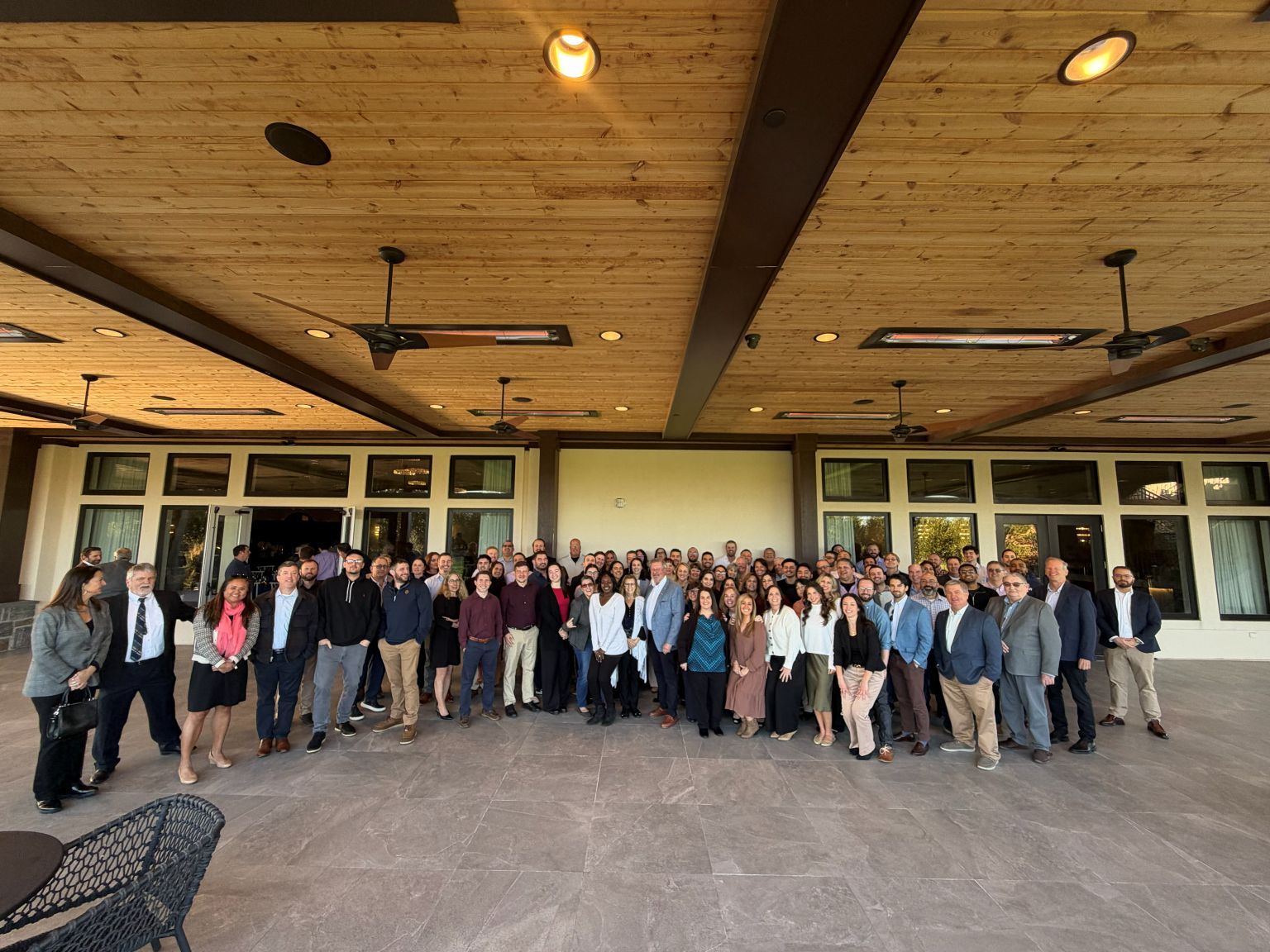

Gary Dahms has worked at T&M Associates for nearly 40 years; he has been its leader for nearly 15. And he says he’s never seen the engineering market this busy.
“The amount of work that’s out there, is very strong and not slowing down,” he said.
Decades of deferred maintenance and new federal spending are pushing more projects into the pipeline, not fewer, Dahms said. The bipartisan infrastructure law alone authorized roughly $1.2 trillion in funding, including hundreds of billions for transportation, water systems and resiliency — exactly the categories firms like T&M live in.
And federal labor projections show civil and environmental engineering roles growing faster than the broader job market over the next decade, as agencies race to deliver on that money.
The problem is not demand. It’s supply.
Inside engineering
Here are two other pieces connected to the 60th anniversary of T&M Associates.
Human engineering: T&M celebrates 60 years of working for communities, caring for people;
Foundation of excellence: How the T&M Foundation became central to the firm’s identity.
“The biggest challenge across the industry is we don’t have enough talent to do the work,” he said. “People like me across the industry, baby boomers, are retiring or retired.”
Dahms then dropped the data.
“There are more retiring engineers every year than there are graduating engineers,” he said.
Education data backs up the trend. While engineering degrees overall have climbed in recent years, much of that growth is in computing and software‑adjacent majors, not in the civil, transportation and environmental disciplines needed to rebuild roads, bridges and water systems. At the same time, baby‑boomer retirements are thinning out the ranks of mid‑career professionals — the 10‑ to 20‑year engineers who manage complex jobs and mentor younger staff.
“There’s this whole challenge of, ‘How do we do the work?’” he said.
That’s where artificial intelligence enters the conversation.
For Dahms, the question is not whether AI will matter, but how.
“There’s no doubt we, the industry, are looking very closely at AI,” he said. “Not how AI can be used to replace the people, but used to make people more efficient, be able to maybe change their job a little bit.
“Instead of doing the work, they let AI do the work, but people still have to be directed.”
Industry groups and software vendors are already pushing AI‑enabled tools that can sift through design options, flag conflicts before construction and automate slices of documentation. The hope is that by taking repetitive work off engineers’ plates, firms can stretch limited staff further — and make the job more appealing to a generation that expects modern tech to be part of the workday.
Dahms sees that evolution accelerating.
“It’s going to be an evolution, and it’s happening quicker than some people would like,” he said. “Every conference I go to, the talent shortage is the number one conversation. And then it’s, ‘How do we leverage AI to help us make up some of that shortage?’”
For firms like T&M, he said, the real competitive edge won’t be choosing between people and technology — it will be getting the mix right.
In a market where the work is effectively guaranteed and the engineers are not, that combination — culture plus smarter tools — may be the only way to keep pace.
“You can’t just flip a switch and get a 15‑year project manager,” he said. “You have to grow them — and you have to give them an environment where they want to stay.”


