


Sean Atitsogbe, better known as Sean the Science Kid — an 11-year-old from Georgia who joined MENSA at age 4 and now has nearly 2 million followers on social media — joked that he has been fascinated by science since ‘he was young.’
Atitsogbe, a special guest Monday night at the 14th annual Genius Gala at the Liberty Science Center in Jersey City, wowed the crowd with his insights and his plans to be the world’s first neuro cardio surgeon, a term he coined himself by combining neurology and cardiology, his two loves.
His story was a delightful detail of the evening. But the event’s message went deeper.
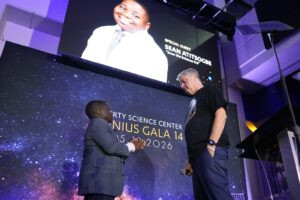
Even in a room in which three incredible scientists were given Genius Awards — and at an event hosted by Paul Hoffman, once described as the “smartest man in the world” — the need for places such as the Liberty Science Center took center stage.
The Genius Gala was a reminder that even prodigies start somewhere — and that kids need a spark.
Dr. David Fajgenbaum, who is pioneering work in repurposing approved drugs as co-founder of the nonprofit Every Cure, talked about how his love for science came from going to the Museum of Natural Sciences in Raleigh, North Carolina, with his mother as a child.
Beth Shapiro, an evolutionary molecular biologist and chief science officer at Colossal Biosciences — someone who is literally trying to bring extinct animals back to life — said her team uses social media to draw attention to science but said it is places like LSC that actually spark it in young minds.
And Hoffman has long said trips to the American Museum of Natural History in New York City as an infant child in a stroller led him on his journey.
On a night in which more than $3.2 million was raised, the question even the world’s greatest minds struggled to answer is why the state would be willing to cut funding to a place where roughly 290,000 school kids visit every year, including about 100,000 from the lowest-income communities.
It’s hard to square that math with the state’s stated commitment to workforce development.
Hoffman politely avoided the question, saying he understands the challenges that come with every budget season. And he acknowledged how much the state has done in regard to previous funding, which includes numerous large tax incentives.
But then he made a strong push for funding, noting why places such as LSC are more important than ever, not only for education but for the business community in the state.
“We need to invest in science,” he said. “This is the next generation of scientists that companies in New Jersey need in their workforce.”
Here’s the thing: We know how this workforce development system works. And we know it takes time and commitment.
“All children are born with a natural curiosity about the world,” Hoffman said. “All kids are little scientists, learning about the world by doing experiments.
SciTech Scity, which includes a magnet high school in its plans, is being built for that very reason. There’s an understanding that a long-term pipeline doesn’t happen by accident.
“All too often in our society, something snuffs out their interest in science as they get older,” Hoffman said. “Liberty Science Center’s mission is to keep their scientific curiosity alive and inspire children to become scientists, surgeons, engineers and innovators.”
Shapiro said the Liberty Science Center connects the next generation to the kinds of experiences that once lit a spark in this year’s honorees. It’s what she aims to do every day.
“One of the most fun things for me about being at Colossal is really the opportunity to reach different audiences,” she told the crowd. “What I really love about places like this is exactly that: This is such an important part of training the next generation, of inspiring people to care about the future, and I really appreciate being part of it.”
Fajgenbaum said his own path started in a museum like this — and that the work being celebrated at the Genius Gala shows just how far that early spark can go.
“As I walked around this incredible center this evening, I keep thinking about my mom,” he told the crowd. “She used to take me to the Museum of Natural Sciences in Raleigh (North Carolina), all the time when I was growing up.
“Going there as a child sparked my early interest in maybe one day going into a career in medicine and science.”
Hoffman stressed the challenge is to keep that interest going. That’s the mission of LSC.
“We try to keep that curiosity alive and, as they get older, we introduce them to paths to STEM careers and find them mentors in their own communities,” he said.
All communities.
“We have to make sure we don’t create another digital divide — people who know how to use technologies like AI and people who don’t,” he said. “Especially for kids from low-income communities, we want them introduced to AI at a young age so they’re not at a disadvantage.”
It doesn’t take a genius to understand that.
Atitsogbe said his own journey started with simple questions.
“It really started at a very young age, when I was around 2,” he said. And he was serious.
“Originally it was just curiosity. I wanted to know how things worked. I didn’t just want to know what they were — I wanted to know the deeper meaning, and that’s what science is all about.”
That’s what Liberty Science Center delivers.
The Genius Gala is an annual outing celebrating the incredible outcomes reached through science. But everyone in the room Monday night knows that journey can begin with a just visit to a place like LSC.


